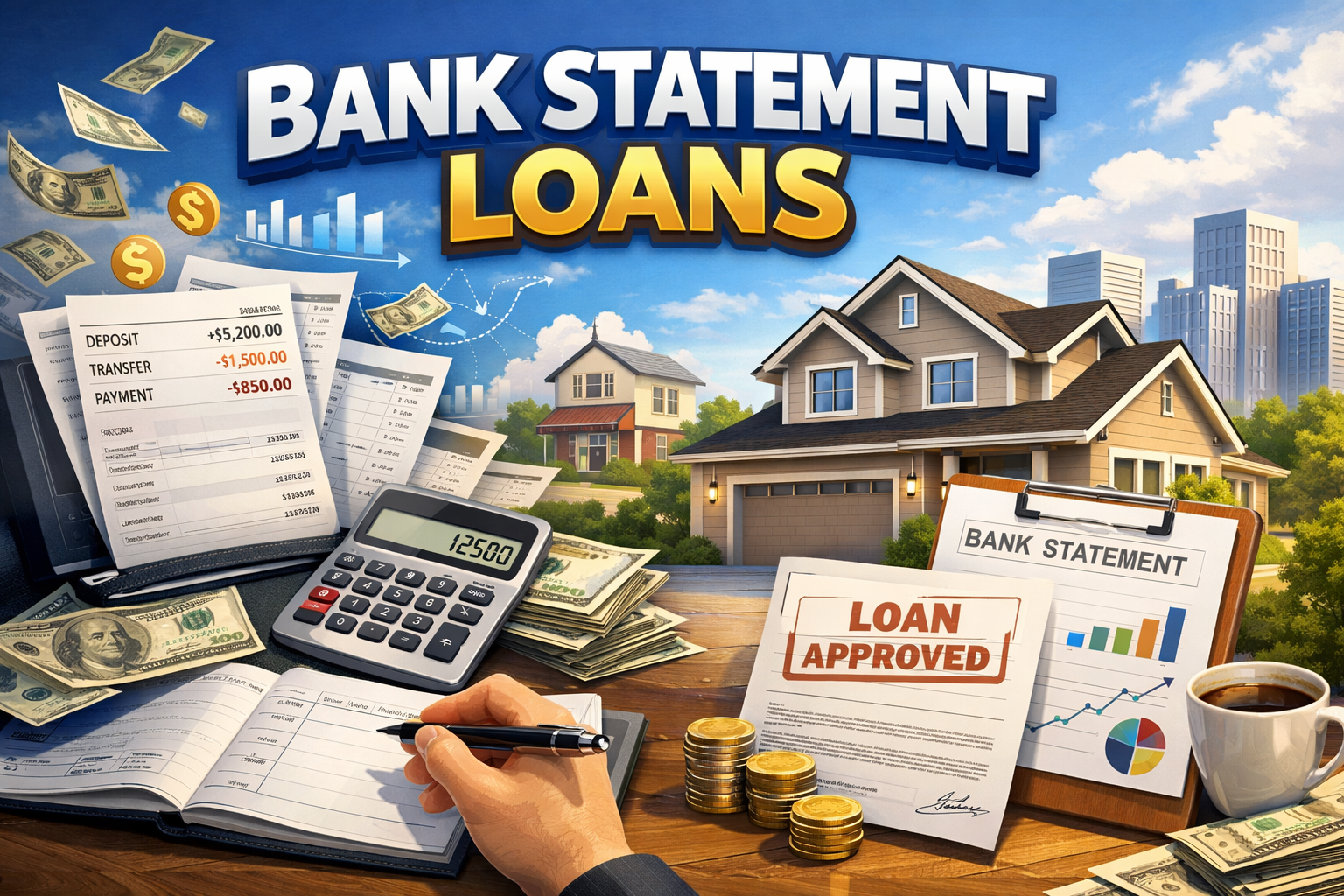
Bank statement loans are non-qualified mortgages designed for self-employed borrowers who verify income using 12–24 months of bank statements instead of tax returns, W-2s, or pay stubs. Lenders analyze average monthly deposits, apply expense factors when necessary, and determine repayment ability under federal Ability-to-Repay guidelines.
Definition and Core Concept
Bank statement loans allow borrowers to qualify for a mortgage using documented deposit history rather than traditional tax documentation. These programs fall under the non-qualified mortgage (Non-QM) category because they do not follow standard underwriting frameworks set by government-sponsored enterprises like Fannie Mae and Freddie Mac.
Instead of reviewing adjusted gross income from tax returns, lenders calculate income based on consistent deposits over 12 or 24 months. This method benefits:
The underwriting objective remains strict compliance with the Ability-to-Repay (ATR) rule established under the Dodd-Frank Wall Street Reform and Consumer Protection Act and enforced by the Consumer Financial Protection Bureau.
The ATR rule requires lenders to make a reasonable, good-faith determination that a borrower has the financial capacity to repay a mortgage before it is originated. This requirement applies to both Qualified Mortgages (QM) and Non-Qualified Mortgages (Non-QM), including bank statement–based programs.
Under ATR standards, lenders must evaluate and document at minimum:
- Current or reasonably expected income or assets
- Current employment status (if income is employment-based)
- Monthly mortgage payment for the subject loan
- Monthly payment on simultaneous loans
- Monthly payments for mortgage-related obligations (taxes, insurance, HOA)
- Current debt obligations, alimony, and child support
- Debt-to-income ratio (DTI) or residual income
- Credit history
For bank statement underwriting specifically, compliance means that deposit-based income calculations must be:
- Fully documented using 12–24 months of statements
- Adjusted using consistent expense factors (for business accounts)
- Supported by trend analysis for income stability
- Reconciled against credit report obligations
Lenders must also maintain detailed underwriting files that demonstrate how income was calculated and how repayment ability was verified. This documentation is critical for regulatory review and secondary market audits.
Unlike pre-2008 “stated income” loans, modern alternative documentation mortgages cannot rely solely on borrower declarations. The ATR rule prohibits no-documentation lending and requires verifiable evidence supporting repayment capacity.
Failure to comply with ATR requirements exposes lenders to:
- Regulatory enforcement actions
- Borrower legal claims
- Loan repurchase demands
- Civil liability penalties
As a result, even though bank statement loans fall outside Qualified Mortgage safe harbor standards, underwriting rigor remains structured, documented, and risk-assessed within federal consumer protection guidelines.
In practical terms, ATR compliance ensures that alternative income verification does not equate to relaxed credit standards. Instead, it shifts the documentation focus from tax-return-based income to verified cash-flow-based income while preserving borrower protection and systemic lending stability.
Why These Loans Exist in Modern Mortgage Lending
Traditional mortgage underwriting relies heavily on standardized income documentation. However, many self-employed borrowers strategically reduce taxable income through deductions, depreciation, and business expense reporting.
While legal and common, these deductions lower reported income on tax returns. As a result:
- Borrowers may appear to earn less than they actually do.
- Conventional underwriting models may underestimate repayment capacity.
- Mortgage eligibility may be restricted.
The expansion of alternative lending frameworks reflects broader labor market changes. According to data from the U.S. Bureau of Labor Statistics, millions of Americans engage in non-traditional employment structures. This shift has influenced the growth of Non-QM lending segments within the mortgage industry.
Bank statement loans address this documentation gap by focusing on real cash flow patterns rather than taxable income figures.
How They Differ from Traditional Mortgages
The core distinction lies in income verification methodology.
Conventional Mortgage Model
Conventional loans typically require:
- Two years of tax returns
- W-2 forms
- Pay stubs
- Employer verification
These loans follow underwriting standards aligned with Fannie Mae and Freddie Mac guidelines.
Government-Backed Loan Model
Government-backed loans such as:
- Federal Housing Administration (FHA)
- U.S. Department of Veterans Affairs (VA)
require traditional income verification but may allow lower credit thresholds or smaller down payments.
Bank Statement Underwriting Model
Under this alternative model:
- 12–24 months of bank statements are reviewed.
- Deposits are averaged.
- Expense ratios may be applied (for business accounts).
- Income volatility is analyzed.
- Debt-to-income ratios are calculated using averaged deposit income.
Mortgage Type Comparison
| Feature | Bank Statement Program | Conventional Loan | FHA Loan | VA Loan |
|---|---|---|---|---|
| Income Proof | 12–24 months bank statements | W-2 + Tax returns | W-2 + Tax returns | W-2 + Tax returns |
| Loan Category | Non-QM | Qualified Mortgage | Government-backed | Government-backed |
| Down Payment | 10–20% typical | 3–20% | 3.5% | 0% |
| Rate Structure | Higher risk-based pricing | Market average | Slightly higher | Often competitive |
| PMI Requirement | May apply | Required under 20% down | Required | None |
How Bank Statement Loans Work
Step 1: Income Averaging
Lenders collect 12 or 24 months of statements. Income is calculated as:
Total eligible deposits ÷ number of months = Average monthly income
For business accounts, lenders may apply a standardized expense factor (e.g., 50%) unless a CPA provides a verified expense ratio.
Example Income Calculation
| Month | Deposits | Expense Factor (50%) | Qualifying Income |
|---|---|---|---|
| January | $20,000 | $10,000 | $10,000 |
| February | $18,000 | $9,000 | $9,000 |
| March | $22,000 | $11,000 | $11,000 |
Average qualifying income = $10,000 per month
This income becomes the basis for debt-to-income evaluation.
Step 2: Debt-to-Income (DTI) Analysis
DTI measures total monthly obligations relative to qualifying income.
Most bank statement loans allow DTIs between 40%–50%, depending on:
- Credit profile
- Down payment size
- Cash reserves
- Compensating factors
Step 3: Credit Risk Assessment
While income documentation is flexible, credit standards remain structured.
Typical minimum credit score range:
- 620–700+
Risk-based pricing increases with lower scores.
Step 4: Cash Reserve Requirement
Because these mortgages are considered higher risk compared to Qualified Mortgages, lenders often require:
- 6–12 months of mortgage reserves
- Liquid or near-liquid assets
- Verified sourcing of funds
Eligibility Requirements Snapshot
| Requirement | Typical Standard |
|---|---|
| Self-Employment History | 2 years preferred |
| Credit Score | 620–700+ |
| Down Payment | 10–20% |
| DTI | Up to 50% |
| Bank Statements | 12–24 months |
| Cash Reserves | 6–12 months |
Regulatory Framework and Compliance
All mortgage lenders must comply with the Ability-to-Repay rule under the Dodd-Frank Wall Street Reform and Consumer Protection Act. Even though these mortgages fall outside Qualified Mortgage standards, lenders must still:
- Verify income
- Assess DTI
- Evaluate employment stability
- Document repayment capacity
The Consumer Financial Protection Bureau requires lenders to demonstrate a reasonable and good-faith determination that a borrower has the ability to repay a mortgage before the loan is finalized. This requirement stems from the Ability-to-Repay (ATR) provisions under the Dodd-Frank Wall Street Reform and Consumer Protection Act and applies to most residential mortgage transactions.
What “Reasonable Determination” Means in Practice
A lender cannot rely on assumptions, verbal statements, or incomplete documentation. Instead, the determination must be:
- Documented
- Evidence-based
- Independently verified
- Consistent with underwriting standards
The CFPB mandates that creditors evaluate specific financial factors before approving a mortgage.
Mandatory Ability-to-Repay Factors
Under federal regulation, lenders must verify and document:
- Current or reasonably expected income or assets
- Current employment status (if employment income is used)
- Monthly mortgage payment for the loan being originated
- Monthly payment on simultaneous loans secured by the same property
- Monthly mortgage-related obligations, including:
- Property taxes
- Homeowners insurance
- HOA dues
- Current debt obligations, including:
- Credit cards
- Auto loans
- Student loans
- Personal loans
- Court-ordered payments
- Debt-to-Income (DTI) ratio or residual income
- Credit history
Each factor must be supported with third-party records such as bank statements, tax transcripts, credit reports, payroll documents, or verified asset statements.
Documentation Standards
To satisfy CFPB expectations, lenders must:
- Maintain written underwriting worksheets
- Show calculation methodology for income
- Document how DTI was derived
- Retain supporting documentation in loan files
- Apply consistent standards across borrowers
For example, when evaluating deposit-based income, lenders must clearly demonstrate:
- How deposits were totaled
- Whether business expense factors were applied
- How inconsistencies were analyzed
- Why the calculated income is considered stable
This documentation protects both the borrower and the lender in the event of regulatory review or litigation.
Legal and Financial Consequences of Non-Compliance
If a lender fails to properly determine repayment ability, the borrower may raise an ATR violation as a defense in foreclosure proceedings. Potential consequences include:
- Civil liability damages
- Statutory penalties
- Regulatory enforcement actions
- Loan rescission rights (in some cases)
- Mandatory repurchase demands
Because of these risks, lenders typically apply conservative underwriting practices even in alternative documentation programs.
Qualified Mortgage (QM) vs Non-Qualified Mortgage (Non-QM)
Loans that meet Qualified Mortgage standards receive certain legal protections (safe harbor or rebuttable presumption). However, even Non-QM loans must still meet ATR requirements.
This means:
- Non-QM does not mean “no verification”
- Alternative documentation does not eliminate income analysis
- Risk-based pricing does not replace repayment evaluation
The distinction lies in documentation structure—not in consumer protection obligations.
Why This Matters for Borrowers
The CFPB’s requirement ensures:
- Borrowers are not approved for unaffordable debt
- Mortgage terms reflect actual financial capacity
- Systemic lending risk is reduced
- Pre-2008 stated-income lending practices are prevented
The Consumer Financial Protection Bureau requires lenders to demonstrate a reasonable and good-faith determination that a borrower has the ability to repay a mortgage before the loan is finalized. This requirement stems from the Ability-to-Repay (ATR) provisions under the Dodd-Frank Wall Street Reform and Consumer Protection Act and applies to most residential mortgage transactions.
What “Reasonable Determination” Means in Practice
A lender cannot rely on assumptions, verbal statements, or incomplete documentation. Instead, the determination must be:
- Documented
- Evidence-based
- Independently verified
- Consistent with underwriting standards
The CFPB mandates that creditors evaluate specific financial factors before approving a mortgage.
Mandatory Ability-to-Repay Factors
Under federal regulation, lenders must verify and document:
- Current or reasonably expected income or assets
- Current employment status (if employment income is used)
- Monthly mortgage payment for the loan being originated
- Monthly payment on simultaneous loans secured by the same property
- Monthly mortgage-related obligations, including:
- Property taxes
- Homeowners insurance
- HOA dues
- Current debt obligations, including:
- Credit cards
- Auto loans
- Student loans
- Personal loans
- Court-ordered payments
- Debt-to-Income (DTI) ratio or residual income
- Credit history
Each factor must be supported with third-party records such as bank statements, tax transcripts, credit reports, payroll documents, or verified asset statements.
Documentation Standards
To satisfy CFPB expectations, lenders must:
- Maintain written underwriting worksheets
- Show calculation methodology for income
- Document how DTI was derived
- Retain supporting documentation in loan files
- Apply consistent standards across borrowers
For example, when evaluating deposit-based income, lenders must clearly demonstrate:
- How deposits were totaled
- Whether business expense factors were applied
- How inconsistencies were analyzed
- Why the calculated income is considered stable
This documentation protects both the borrower and the lender in the event of regulatory review or litigation.
Legal and Financial Consequences of Non-Compliance
If a lender fails to properly determine repayment ability, the borrower may raise an ATR violation as a defense in foreclosure proceedings. Potential consequences include:
- Civil liability damages
- Statutory penalties
- Regulatory enforcement actions
- Loan rescission rights (in some cases)
- Mandatory repurchase demands
Because of these risks, lenders typically apply conservative underwriting practices even in alternative documentation programs.
Qualified Mortgage (QM) vs Non-Qualified Mortgage (Non-QM)
Loans that meet Qualified Mortgage standards receive certain legal protections (safe harbor or rebuttable presumption). However, even Non-QM loans must still meet ATR requirements.
This means:
- Non-QM does not mean “no verification”
- Alternative documentation does not eliminate income analysis
- Risk-based pricing does not replace repayment evaluation
The distinction lies in documentation structure—not in consumer protection obligations.
Why This Matters for Borrowers
The CFPB’s requirement ensures:
- Borrowers are not approved for unaffordable debt
- Mortgage terms reflect actual financial capacity
- Systemic lending risk is reduced
- Pre-2008 stated-income lending practices are prevented
The Consumer Financial Protection Bureau requires lenders to demonstrate a reasonable and good-faith determination that a borrower has the ability to repay a mortgage before the loan is finalized. This requirement stems from the Ability-to-Repay (ATR) provisions under the Dodd-Frank Wall Street Reform and Consumer Protection Act and applies to most residential mortgage transactions, including alternative documentation programs such as bank statement loans.
Under federal law, lenders cannot approve a mortgage based on assumptions, projected appreciation, or incomplete financial review. Instead, they must verify and document that the borrower has sufficient income or assets to meet ongoing payment obligations. This standard applies equally to conventional mortgages and bank statement loans, even though the latter fall under the Non-Qualified Mortgage (Non-QM) category.
Core Purpose of the Ability-to-Repay Rule
The ATR rule was implemented to prevent a return to pre-2008 “stated income” lending practices. Before regulatory reform, some loans were issued without verified income documentation, increasing systemic financial risk. Today, even bank statement loans must meet structured underwriting benchmarks.
The CFPB requires lenders to evaluate eight specific factors when determining repayment ability:
- Current or reasonably expected income or assets
- Employment status (if employment income is used)
- Monthly payment for the loan
- Monthly payment on simultaneous loans
- Mortgage-related obligations (taxes, insurance, HOA fees)
- Current debt obligations
- Debt-to-Income (DTI) ratio or residual income
- Credit history
Each factor must be supported with documented evidence. For bank statement loans, income verification is derived from deposit analysis rather than tax transcripts, but the obligation to verify stability remains unchanged.
Documentation Standards in Alternative Income Programs
For bank statement loans, lenders typically analyze 12–24 months of personal or business bank statements. However, ATR compliance requires more than simply averaging deposits. Lenders must:
- Identify recurring income patterns
- Exclude non-income transfers
- Apply standardized expense factors to business accounts
- Analyze seasonality or volatility
- Reconcile deposit trends with credit obligations
This means bank statement loans are subject to structured cash-flow validation rather than relaxed underwriting.
If business statements are used in bank statement loans, many lenders apply a default expense ratio—often around 50%—to approximate operating costs unless a CPA provides verified documentation supporting a lower expense percentage. This standardized adjustment helps ensure that income used for qualification reflects net business cash flow rather than gross deposits.
In bank statement loans, the adjusted figure becomes the qualifying income for DTI analysis. For example, if monthly business deposits average $20,000 and a 50% expense factor is applied, only $10,000 would be considered usable income for underwriting purposes. This methodology allows lenders offering bank statement loans to apply consistent risk controls while still accommodating self-employed borrowers whose tax returns may not accurately reflect earning capacity.
Debt-to-Income (DTI) Evaluation
Under ATR rules, lenders must calculate the borrower’s DTI ratio based on verified income. For bank statement loans, this involves:
- Calculating average monthly qualifying income
- Adding total monthly debt obligations
- Dividing debt by income
For example:
- Qualifying income: $10,000/month
- Total debt obligations: $4,000/month
- DTI: 40%
Even though bank statement loans are Non-QM products, lenders still apply internal DTI thresholds, often capped between 40% and 50% depending on credit strength and reserves.
Legal Accountability and Enforcement
Failure to comply with ATR standards can expose lenders to significant legal consequences, particularly when originating bank statement loans, which already fall outside Qualified Mortgage safe harbor protections. Borrowers may assert ATR violations as a defense in foreclosure proceedings, including cases involving bank statement loans where income calculations or deposit analyses were improperly documented. Civil penalties, statutory damages, and regulatory enforcement actions may follow if documentation standards are not met, especially if underwriting files for bank statement loans fail to demonstrate a reasonable and good-faith determination of repayment ability.
In addition to borrower litigation risk, lenders that originate bank statement loans without proper ATR compliance may face:
- Regulatory investigations
- Monetary fines
- Loan repurchase demands from investors
- Increased supervisory scrutiny
- Reputational damage within secondary markets
Because Non-QM products carry heightened scrutiny, documentation integrity is critical. Courts reviewing ATR claims examine whether the lender verified income using reliable third-party records, applied consistent underwriting methodology, and reasonably evaluated debt obligations. If a lender cannot demonstrate these elements, the mortgage may be challenged as non-compliant.
This legal exposure is one of the primary reasons underwriting for alternative documentation programs—particularly bank statement loans—remains structured, documented, and evidence-based despite their income verification flexibility. Because bank statement loans fall under Non-QM classifications, lenders must apply disciplined review standards to demonstrate full compliance with Ability-to-Repay requirements.
Proper ATR adherence protects both borrowers and lenders by ensuring that bank statement loans are approved based on verified deposit history, documented debt analysis, and measurable repayment capacity rather than unverified income assumptions. Without this compliance framework, bank statement loans could expose lenders to litigation risk, regulatory penalties, and loan repurchase demands.
By maintaining detailed income calculation worksheets, deposit trend evaluations, and DTI documentation, lenders ensure that bank statement loans reflect sustainable financial capacity. This structured underwriting approach reinforces market stability while preserving responsible access to credit for self-employed borrowers.
Because of this liability exposure, lenders offering bank statement loans maintain detailed underwriting files showing:
- Deposit calculations
- Income adjustment methodology
- DTI computation worksheets
- Asset verification
- Credit risk assessment
This documentation ensures that bank statement loans remain compliant with federal consumer protection laws.
Qualified Mortgage (QM) vs Non-Qualified Mortgage (Non-QM)
Qualified Mortgages receive certain legal protections if they meet strict criteria established by the CFPB. However, bank statement loans typically fall outside QM classification because they use alternative income documentation.
Importantly:
- Non-QM does not mean no documentation
- Non-QM does not mean no income verification
- Non-QM does not remove ATR obligations
Instead, bank statement loans operate under a different documentation framework while still meeting repayment ability standards.
Risk Management and Systemic Stability
From a regulatory perspective, ATR compliance reduces:
- Default probability
- Foreclosure risk
- Predatory lending practices
- Systemic financial instability
Even though bank statement loans offer flexible income verification for self-employed borrowers, they are structured within a compliance framework that prioritizes borrower protection.
By requiring lenders to demonstrate repayment capacity, the CFPB ensures that bank statement loans are based on verified financial strength rather than speculative approval practices.
Why This Matters for Borrowers
For self-employed individuals and business owners, bank statement loans provide access to mortgage financing without relying solely on tax return income. However, borrowers must still demonstrate:
- Stable deposit history
- Responsible credit management
- Manageable debt ratios
- Sufficient reserves
The ATR rule guarantees that bank statement loans remain responsibly underwritten, balancing flexibility with regulatory oversight.
In practical terms, the reasonable and good-faith determination requirement ensures that mortgage approval—whether conventional or through bank statement loans—is grounded in documented financial reality rather than optimistic projections.
What “Reasonable Determination” Means in Practice
A lender cannot rely on assumptions, verbal statements, or incomplete documentation. Instead, the determination must be:
- Documented
- Evidence-based
- Independently verified
- Consistent with underwriting standards
The CFPB mandates that creditors evaluate specific financial factors before approving a mortgage.
Mandatory Ability-to-Repay Factors
Under federal regulation, lenders must verify and document:
- Current or reasonably expected income or assets
- Current employment status (if employment income is used)
- Monthly mortgage payment for the loan being originated
- Monthly payment on simultaneous loans secured by the same property
- Monthly mortgage-related obligations, including:
- Property taxes
- Homeowners insurance
- HOA dues
- Current debt obligations, including:
- Credit cards
- Auto loans
- Student loans
- Personal loans
- Court-ordered payments
- Debt-to-Income (DTI) ratio or residual income
- Credit history
Each factor must be supported with third-party records such as bank statements, tax transcripts, credit reports, payroll documents, or verified asset statements.
Documentation Standards
To satisfy CFPB expectations, lenders must:
- Maintain written underwriting worksheets
- Show calculation methodology for income
- Document how DTI was derived
- Retain supporting documentation in loan files
- Apply consistent standards across borrowers
For example, when evaluating deposit-based income, lenders must clearly demonstrate:
- How deposits were totaled
- Whether business expense factors were applied
- How inconsistencies were analyzed
- Why the calculated income is considered stable
This documentation protects both the borrower and the lender in the event of regulatory review or litigation.
Legal and Financial Consequences of Non-Compliance
If a lender fails to properly determine repayment ability, the borrower may raise an ATR violation as a defense in foreclosure proceedings. Potential consequences include:
- Civil liability damages
- Statutory penalties
- Regulatory enforcement actions
- Loan rescission rights (in some cases)
- Mandatory repurchase demands
Because of these risks, lenders typically apply conservative underwriting practices even in alternative documentation programs.
Qualified Mortgage (QM) vs Non-Qualified Mortgage (Non-QM)
Loans that meet Qualified Mortgage standards receive certain legal protections (safe harbor or rebuttable presumption). However, even Non-QM loans must still meet ATR requirements.
This means:
- Non-QM does not mean “no verification”
- Alternative documentation does not eliminate income analysis
- Risk-based pricing does not replace repayment evaluation
The distinction lies in documentation structure—not in consumer protection obligations.
Why This Matters for Borrowers
The CFPB’s requirement ensures:
- Borrowers are not approved for unaffordable debt
- Mortgage terms reflect actual financial capacity
- Systemic lending risk is reduced
- Pre-2008 stated-income lending practices are prevented
In effect, the reasonable determination standard creates a balance between credit access flexibility and consumer financial protection.
This regulatory oversight reduces systemic risk compared to pre-2008 alternative documentation loans.
Pros and Cons Overview
Advantages
- Flexible income documentation
- Useful for high-deduction borrowers
- Recognizes real cash flow
- Potentially faster underwriting
Disadvantages
- Higher interest rates
- Larger down payment
- Stricter reserve requirements
- Limited lender availability
Risk vs Flexibility Comparison
| Factor | Traditional Mortgage | Bank Statement Structure |
|---|---|---|
| Documentation Strictness | High | Moderate |
| Interest Rate | Lower | Higher |
| Income Flexibility | Low | High |
| Regulatory Oversight | Standard QM | Non-QM with ATR compliance |
| Suitability | W-2 employees | Self-employed |
Who Should Consider This Loan Type?
Self-Employed Professionals
Entrepreneurs, consultants, medical professionals, and contractors whose taxable income does not reflect actual earnings.
Real Estate Investors
Borrowers managing multiple properties with fluctuating income streams.
Gig Economy Workers
Individuals earning through contract platforms with inconsistent pay cycles.
Business Owners with High Write-Offs
Those using accelerated depreciation or large expense deductions.
Summary Points
- Alternative mortgage for self-employed borrowers
- Income verified via deposit history
- Falls under Non-QM lending
- Requires strong credit and reserves
- Higher rates reflect underwriting risk
- Complies with federal Ability-to-Repay rules
Common Qualification Mistakes
- Large unexplained deposits
- Overdraft history
- Inconsistent monthly revenue
- High revolving debt utilization
- Insufficient reserves
Key Takeaway Box
Bank statement loans prioritize cash flow consistency over tax return income.
Approval depends on deposit stability, credit strength, debt ratio management, and liquidity reserves rather than traditional employment documentation.also read: https://fundbulletins.com/wp-admin/post.php?post=4403&action=edit
Interest Rates and Pricing Structure
Interest rates on bank statement loans are typically higher than those of Qualified Mortgages because lenders assume elevated underwriting risk. Since these mortgages fall outside conforming standards established by Fannie Mae and Freddie Mac, pricing reflects risk-based adjustments.
Why Rates Are Higher
Several measurable factors influence pricing:
- Non-QM classification
- Alternative income verification
- Higher loan-to-value (LTV) risk
- Self-employment income volatility
- Reduced secondary market liquidity
Unlike conforming loans, bank statement loans are not eligible for standardized securitization channels supported by government-sponsored enterprises. This reduces investor demand and increases capital cost.
Key Pricing Variables
| Factor | Impact on Rate |
|---|---|
| Credit Score | Lower score = higher rate |
| Down Payment | Higher equity = lower rate |
| DTI Ratio | Higher DTI = risk premium |
| Cash Reserves | Strong reserves may reduce pricing |
| Property Type | Investment properties cost more |
Rates may vary 0.50% to 2.00% above comparable conforming mortgage rates depending on borrower profile.
Points and Fees
Many lenders offer rate buydown options:
- 1 point = 1% of loan amount
- Reduces interest rate by approximately 0.25% (varies by lender)
Borrowers evaluating bank statement loans should analyze the breakeven timeline before purchasing discount points.
Loan-to-Value (LTV) and Down Payment Requirements
Loan-to-Value ratio directly impacts approval probability.
| Down Payment | Typical LTV |
|---|---|
| 10% | 90% LTV |
| 15% | 85% LTV |
| 20% | 80% LTV |
| 25%+ | 75% LTV or lower |
Higher down payments reduce risk exposure and may significantly improve pricing.
Private Mortgage Insurance (PMI)
Unlike conforming loans, many bank statement loans structure risk directly into interest rates rather than requiring traditional PMI. However, some lenders may impose lender-paid mortgage insurance equivalents through rate adjustments.
Step-by-Step Application Process
Understanding the process improves approval efficiency.
1. Prequalification
Borrower submits:
- Estimated income
- Credit score
- Property details
- Asset snapshot
Lender conducts preliminary DTI and LTV assessment.
2. Documentation Preparation
Required documents typically include:
- 12–24 months personal or business bank statements
- Government-issued identification
- Business license (if applicable)
- CPA letter (optional but beneficial)
- Asset statements for reserves
Proper documentation reduces underwriting delays.
3. Income Analysis and Underwriting
Underwriters evaluate:
- Deposit consistency
- Large deposit explanations
- Overdraft frequency
- Expense factor application
- Debt obligations
All lenders must comply with the Ability-to-Repay rule under the Dodd-Frank Wall Street Reform and Consumer Protection Act and regulations enforced by the Consumer Financial Protection Bureau.
4. Conditional Approval
Conditions may include:
- Updated bank statements
- Explanation letters
- Additional asset verification
- Appraisal clearance
5. Closing
Average timeline: 30–45 days
Complex files may extend beyond 45 days.
Bank Statement Loans vs Other Non-QM Options
Non-QM lending includes multiple alternative documentation programs.
Asset Depletion Loans
Income derived from liquid assets rather than deposits.
DSCR Loans
Debt Service Coverage Ratio loans qualify based on rental income performance rather than personal income.
Interest-Only Non-QM Loans
Allow lower initial payments but increase long-term cost.
Non-QM Comparison Table
| Feature | Bank Statement | Asset Depletion | DSCR Loan |
|---|---|---|---|
| Income Source | Deposits | Assets | Rental cash flow |
| Self-Employment Required | Yes (typically) | No | No |
| Ideal Borrower | Business owner | High net worth | Investor |
| Risk Level | Moderate | Moderate | Investment risk |
Risks and Regulatory Considerations
Though structured under Non-QM guidelines, these mortgages remain subject to federal consumer protection laws.
The Consumer Financial Protection Bureau mandates lenders verify repayment capacity through documented analysis.
The Dodd-Frank Wall Street Reform and Consumer Protection Act prohibits unsafe “no-doc” lending practices that contributed to the 2008 financial crisis.
Modern bank statement loans differ substantially from pre-crisis stated-income loans due to:
- Mandatory ATR compliance
- Documented deposit verification
- Risk-based pricing transparency
- Enhanced underwriting documentation
Common Reasons for Denial
- Inconsistent revenue patterns
- Excessive overdrafts
- High revolving debt utilization
- Unverifiable large deposits
- Insufficient cash reserves
- Credit score below program threshold
Improving financial stability before applying significantly increases approval probability.
How to Improve Approval Odds
- Reduce credit utilization below 30%
- Increase liquidity reserves
- Maintain deposit consistency for 6–12 months
- Avoid large unexplained transfers
- Strengthen credit score above 700 if possible
Borrowers preparing strategically for bank statement loans often receive better pricing and smoother underwriting outcomes.
Conclusion
Bank statement loans provide a structured alternative mortgage pathway for self-employed borrowers whose tax returns do not reflect actual earning capacity. While pricing is higher due to Non-QM classification, strong credit, stable deposits, and sufficient reserves significantly enhance approval potential. Regulatory oversight under federal Ability-to-Repay standards ensures responsible underwriting practices.
Frequently Asked Questions (FAQs)
1. Are bank statement loans hard to qualify for?
They require strong deposit consistency, adequate reserves, and solid credit. Approval depends more on cash flow stability than tax documentation.
2. What credit score is needed?
Most lenders require a minimum of 620–700, though higher scores improve pricing.
3. Do I need tax returns?
Typically no. Income is verified using 12–24 months of bank statements.
4. Are rates higher?
Yes. Because they are Non-QM loans, risk-based pricing generally results in higher interest rates.
5. How many months of bank statements are required?
Most programs require either 12 or 24 months.
6. Can first-time buyers qualify?
Yes, if they meet self-employment and credit requirements.
7. Are these loans safe?
Yes. Modern programs must comply with federal Ability-to-Repay regulations.
References
- Consumer Financial Protection Bureau (CFPB)
https://www.consumerfinance.gov/ - Dodd-Frank Act Overview – U.S. Congress
https://www.congress.gov/ - Fannie Mae Selling Guide
https://selling-guide.fanniemae.com/ - Freddie Mac Single-Family Seller/Servicer Guide
https://guide.freddiemac.com/ - U.S. Bureau of Labor Statistics – Self-Employment Data
https://www.bls.gov/ - Mortgage Bankers Association
https://www.mba.org/
Disclaimer:
The content provided is for informational purposes only and does not constitute financial, investment, legal, or tax advice. While efforts are made to ensure accuracy, no guarantees are given regarding completeness or reliability. Any action you take upon the information is strictly at your own risk. We recommend consulting a licensed financial advisor or professional before making financial decisions