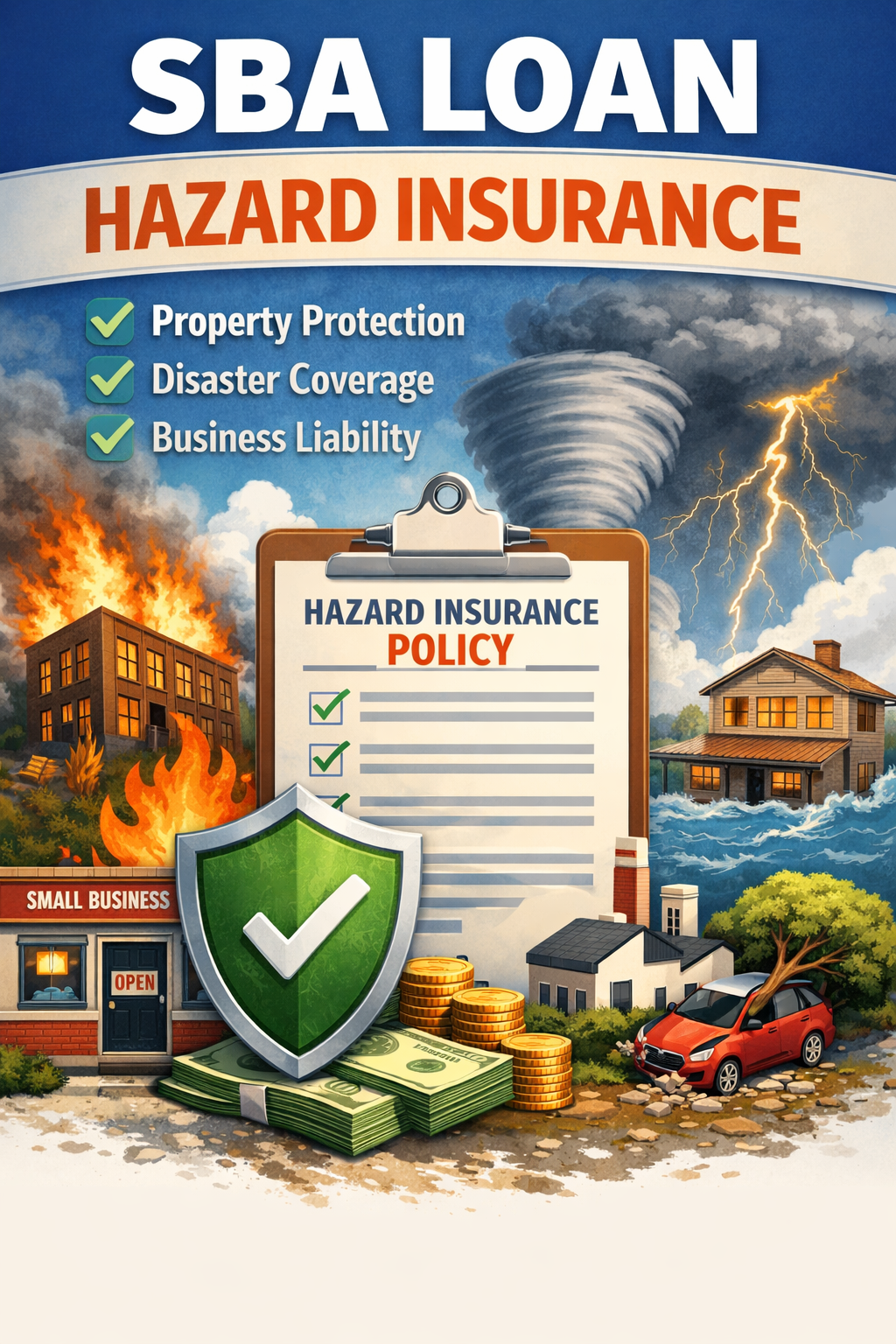
SBA loan hazard insurance is a commercial property insurance requirement imposed when business assets are pledged as collateral. It protects buildings and equipment against physical damage such as fire, wind, or vandalism. Coverage must typically meet replacement cost standards and list the lender as loss payee to ensure compliance.
Definition in SBA Lending Context
Hazard insurance is a form of commercial property insurance that protects pledged collateral from physical damage. When a borrower secures financing with real estate, machinery, or business equipment, the lender requires protection against risks that could reduce asset value.
Under guidelines published by the U.S. Small Business Administration, lenders must ensure that collateral supporting a government-guaranteed loan is adequately insured through SBA loan hazard insurance. This requirement functions as a formal risk mitigation standard embedded in SBA servicing policies to protect collateral value and preserve federal guarantee integrity.
Hazard insurance covers structural and property-level physical risks. It does not replace liability insurance, workers’ compensation, or business interruption policies.
Why the SBA Requires Hazard Insurance
The SBA guarantee reduces lender exposure, but it does not eliminate collateral risk. Without proper SBA loan hazard insurance, if insured property is destroyed and uninsured, both lender recovery potential and government guarantee exposure increase significantly, weakening the secured position of the loan.
According to SBA servicing standards (SOP 50 10), lenders must:
- Protect collateral securing the loan
- Maintain documentation of active insurance
- Ensure coverage equals replacement cost where available
- Be listed as loss payee on the policy
This requirement aligns with broader commercial underwriting practices used in secured lending markets.
Key Compliance Principle:
If collateral exists, insurance must protect it.
When It Is Mandatory
Hazard insurance is required when:
- Commercial real estate secures the loan
- Equipment or machinery is pledged
- Construction collateral is involved
- Disaster loans involve physical property
It may not apply if the loan is unsecured and no physical collateral supports repayment.
Hazard Insurance vs Other Business Insurance Types
| Insurance Type | Protects Against | Required for SBA Collateral? | Covers Physical Structure? | Covers Lawsuits? |
|---|---|---|---|---|
| Hazard Insurance | Fire, wind, vandalism | Yes (if collateral exists) | Yes | No |
| General Liability | Third-party injury/property damage | Often required | No | Yes |
| Business Interruption | Income loss | Conditional | No | No |
| Flood Insurance | Flood damage | Required in flood zones | Yes | No |
Short Takeaway: Hazard coverage protects assets; liability insurance protects against claims.
SBA Hazard Insurance Requirements by Loan Program
SBA 7(a) Loan Program
The SBA 7(a) Loan Program requires lenders to ensure that collateralized real estate and equipment are insured against hazards. The lender determines adequacy, but SBA servicing rules mandate documentation and compliance.
Key compliance points:
- Replacement cost coverage when feasible
- Lender listed as loss payee
- Annual verification during servicing
- Deductibles must be commercially reasonable
SBA 504 Loan Program
The SBA 504 Loan Program primarily finances owner-occupied commercial real estate and heavy equipment.
Because these loans involve fixed assets:
- Hazard insurance is almost always mandatory
- Coverage must reflect full insurable value
- Both lender and Certified Development Company (CDC) interests must be protected
Failure to maintain coverage may violate loan covenants.
SBA Disaster Loan Program
The SBA Disaster Loan Program frequently requires borrowers to obtain and maintain SBA loan hazard insurance after loan approval. Borrowers must secure compliant SBA loan hazard insurance to protect repaired or replaced collateral against physical damage risks. In flood-prone regions identified by the Federal Emergency Management Agency, flood insurance may also be mandatory in addition to SBA loan hazard insurance to meet full federal compliance standards.
Comparison Table: SBA Program vs Insurance Requirement
| SBA Program | Hazard Insurance Required? | Typical Collateral | Replacement Cost Standard |
|---|---|---|---|
| 7(a) | Yes (if collateral pledged) | Real estate, equipment | Yes |
| 504 | Yes (almost always) | Commercial property | Yes |
| Disaster | Yes (post-repair) | Damaged assets | Yes |
| Express | Conditional | Equipment | Yes |
How Much Coverage Is Required?
Replacement Cost vs Loan Balance
Most lenders require coverage equal to:
- Full replacement cost of the property, or
- The maximum insurable value available
Replacement cost means the amount needed to rebuild or replace property without depreciation deductions.
Actual Cash Value (ACV) may not be acceptable unless explicitly approved.
Coverage Calculation Example
| Property Type | Replacement Cost | Loan Balance | Required Insurance |
|---|---|---|---|
| Office Building | $800,000 | $600,000 | $800,000 |
| Warehouse | $1,200,000 | $1,500,000 | $1,200,000 |
| Equipment | $250,000 | $200,000 | $250,000 |
Rule: Coverage generally follows replacement value, not loan amount.
Coinsurance Clauses Explained
Many commercial policies contain a coinsurance clause requiring the insured to carry coverage equal to a specified percentage (often 80–100%) of replacement value.
If underinsured, claim payouts may be reduced proportionally.
This is why lenders review policy declarations carefully.
Deductible Standards
Deductibles must be:
- Commercially reasonable
- Not so high that they undermine protection
- Approved by the lender
Excessive deductibles may violate servicing guidelines.
What Hazards Are Covered?
Typical perils include:
- Fire and lightning
- Windstorm and hail
- Explosion
- Riot or civil commotion
- Vandalism
- Smoke damage
Some policies include theft coverage for equipment.
Common Exclusions
Hazard insurance generally does not cover:
- Flood (requires separate policy)
- Earthquake (endorsement needed)
- Wear and tear
- Intentional damage
Flood coverage may be required under the National Flood Insurance Program if the property lies within a Special Flood Hazard Area.
What Happens If Coverage Lapses?
Failure to maintain required coverage can trigger:
1. Force-Placed Insurance
The lender may purchase insurance on behalf of the borrower and charge the premium. This is typically more expensive and offers limited coverage.
2. Technical Default
Insurance lapse may violate loan agreements, leading to default status.
3. Increased SBA Scrutiny
Servicing files must show active insurance. Missing documentation can affect lender compliance reviews.
Risk Summary
Risks of Non-Compliance:
- Higher insurance cost
- Default risk
- Collateral exposure
- Reduced claim recovery
How to Obtain Compliant Coverage
Required Policy Features
- Replacement cost valuation
- Lender listed as loss payee
- Correct insured business name
- Coverage equal to insurable value
- Policy term matching loan servicing year
Cost Factors
Premium costs vary by:
- Property location
- Construction type
- Claims history
- Coverage limits
- Deductible size
Industry data suggests that SBA loan hazard insurance premiums for small commercial property policies often range between 0.1% and 0.5% of the insured property value annually, depending on location, construction type, claims history, and other underwriting risk factors (based on commercial underwriting benchmarks).
Common Borrower Mistakes
- Underinsuring property
- Using ACV instead of replacement cost
- Failing to add lender endorsement
- Allowing policy lapse
- Incorrect property description
Compliance Checklist
| Step | Action | Completed? |
|---|---|---|
| 1 | Confirm collateral type | ☐ |
| 2 | Obtain replacement cost valuation | ☐ |
| 3 | Secure commercial property policy | ☐ |
| 4 | Add lender as loss payee | ☐ |
| 5 | Submit certificate to lender | ☐ |
| 6 | Renew annually before expiration | ☐ |
Summary
SBA loan hazard insurance protects physical collateral pledged under SBA financing programs. Proper SBA loan hazard insurance coverage must meet replacement cost standards, list the lender as loss payee, and remain active throughout the loan term. While requirements may vary slightly by program, maintaining compliant SBA loan hazard insurance is mandatory whenever physical assets secure repayment under federal lending guidelines.
What Is SBA Loan Hazard Insurance?
SBA loan hazard insurance is a commercial property insurance requirement imposed when business assets are pledged as collateral. It protects buildings and equipment against physical damage such as fire, wind, or vandalism. Coverage must typically meet replacement cost standards and list the lender as loss payee to ensure compliance.
Definition in SBA Lending Context
SBA loan hazard insurance in the SBA lending context is a commercial property insurance requirement designed to protect pledged collateral from physical damage risks. Borrowers obtaining secured financing for real estate, machinery, or business equipment must maintain SBA loan hazard insurance because lenders need protection against asset value loss that could affect repayment recovery. Under guidelines published by the U.S. Small Business Administration, adequate SBA loan hazard insurance is required for government-guaranteed loans as part of standardized risk mitigation and servicing compliance policies. SBA loan hazard insurance typically covers structural and property-level hazards such as fire, windstorm, vandalism, or explosion but does not substitute liability insurance, workers’ compensation coverage, or business interruption insurance. Maintaining active SBA loan hazard insurance throughout the loan term helps preserve collateral security, supports underwriting integrity, and reduces financial exposure for both borrowers and lenders.
Why the SBA Requires Hazard Insurance
The SBA guarantee reduces lender exposure, but it does not eliminate collateral risk. If insured property is destroyed and uninsured, both lender recovery and government guarantee exposure increase.
According to SBA servicing standards (SOP 50 10), lenders must:
- Protect collateral securing the loan
- Maintain documentation of active insurance
- Ensure coverage equals replacement cost where available
- Be listed as loss payee on the policy
This requirement aligns with broader commercial underwriting practices used in secured lending markets.
Key Compliance Principle:
If collateral exists, insurance must protect it.
When It Is Mandatory
Hazard insurance is required when:
- Commercial real estate secures the loan
- Equipment or machinery is pledged
- Construction collateral is involved
- Disaster loans involve physical property
It may not apply if the loan is unsecured and no physical collateral supports repayment.
Hazard Insurance vs Other Business Insurance Types
| Insurance Type | Protects Against | Required for SBA Collateral? | Covers Physical Structure? | Covers Lawsuits? |
|---|---|---|---|---|
| Hazard Insurance | Fire, wind, vandalism | Yes (if collateral exists) | Yes | No |
| General Liability | Third-party injury/property damage | Often required | No | Yes |
| Business Interruption | Income loss | Conditional | No | No |
| Flood Insurance | Flood damage | Required in flood zones | Yes | No |
Short Takeaway: Hazard coverage protects assets; liability insurance protects against claims.
SBA Hazard Insurance Requirements by Loan Program
SBA 7(a) Loan Program
The SBA loan hazard insurance requirement is applied within the SBA 7(a) Loan Program framework, where lenders must ensure that collateralized real estate and equipment are properly insured against physical hazards. Although the lender determines the adequacy of coverage, SBA servicing regulations require strict documentation and ongoing compliance verification. Maintaining appropriate SBA loan hazard insurance helps protect secured assets, supports government guarantee conditions, and reduces recovery risk in the event of property damage. Properly structured SBA loan hazard insurance policies must remain active for the loan’s life cycle to satisfy federal servicing standards and collateral protection expectations.
Key compliance points:
- Replacement cost coverage when feasible
- Lender listed as loss payee
- Annual verification during servicing
- Deductibles must be commercially reasonable
SBA 504 Loan Program
The SBA 504 Loan Program primarily finances owner-occupied commercial real estate and heavy equipment.
Because these loans involve fixed assets:
- Hazard insurance is almost always mandatory
- Coverage must reflect full insurable value
- Both lender and Certified Development Company (CDC) interests must be protected
Failure to maintain coverage may violate loan covenants.
SBA Disaster Loan Program
The SBA Disaster Loan Program frequently requires borrowers to obtain and maintain hazard coverage after loan approval.
Borrowers are required to maintain SBA loan hazard insurance and must insure damaged collateral once it has been repaired or replaced to ensure continuous asset protection under lending compliance standards. In flood-prone regions identified by the Federal Emergency Management Agency, additional flood insurance coverage may be mandatory alongside SBA loan hazard insurance to satisfy federal risk management and disaster mitigation requirements. Maintaining active SBA loan hazard insurance protects collateral value, supports loan servicing compliance, and reduces financial exposure associated with natural disaster events.
Comparison Table: SBA Program vs Insurance Requirement
| SBA Program | Hazard Insurance Required? | Typical Collateral | Replacement Cost Standard |
|---|---|---|---|
| 7(a) | Yes (if collateral pledged) | Real estate, equipment | Yes |
| 504 | Yes (almost always) | Commercial property | Yes |
| Disaster | Yes (post-repair) | Damaged assets | Yes |
| Express | Conditional | Equipment | Yes |
How Much Coverage Is Required?
Replacement Cost vs Loan Balance
Most lenders require coverage equal to:
- Full replacement cost of the property, or
- The maximum insurable value available
Replacement cost means the amount needed to rebuild or replace property without depreciation deductions.
Actual Cash Value (ACV) may not be acceptable unless explicitly approved.
Coverage Calculation Example
| Property Type | Replacement Cost | Loan Balance | Required Insurance |
|---|---|---|---|
| Office Building | $800,000 | $600,000 | $800,000 |
| Warehouse | $1,200,000 | $1,500,000 | $1,200,000 |
| Equipment | $250,000 | $200,000 | $250,000 |
Rule: Coverage generally follows replacement value, not loan amount.
also read: https://fundbulletins.com/maxlend-loans/
Coinsurance Clauses Explained
Many commercial property policies that support SBA loan hazard insurance requirements may contain a coinsurance clause requiring the insured to carry coverage equal to a specified percentage—often between 80% and 100% of the property’s replacement value. When maintaining compliant SBA loan hazard insurance, borrowers should carefully review coinsurance provisions because underinsurance can reduce claim payouts proportionally and weaken collateral protection. Ensuring adequate SBA loan hazard insurance limits helps align with commercial underwriting standards, lender servicing expectations, and federal guarantee program requirements for secured lending assets.
If underinsured, claim payouts may be reduced proportionally.
This is why lenders review policy declarations carefully.
Deductible Standards
Deductibles must be:
- Commercially reasonable
- Not so high that they undermine protection
- Approved by the lender
Excessive deductibles may violate servicing guidelines.
What Hazards Are Covered?
Typical perils include:
- Fire and lightning
- Windstorm and hail
- Explosion
- Riot or civil commotion
- Vandalism
- Smoke damage
Some policies include theft coverage for equipment.
Common Exclusions
Hazard insurance generally does not cover:
- Flood (requires separate policy)
- Earthquake (endorsement needed)
- Wear and tear
- Intentional damage
Flood coverage may be required under the National Flood Insurance Program if the property lies within a Special Flood Hazard Area.
What Happens If Coverage Lapses?
Failure to maintain required coverage can trigger:
1. Force-Placed Insurance
The lender may purchase insurance on behalf of the borrower and charge the premium. This is typically more expensive and offers limited coverage.
2. Technical Default
Insurance lapse may violate loan agreements, leading to default status.
3. Increased SBA Scrutiny
Servicing files must show active insurance. Missing documentation can affect lender compliance reviews.
Risk Summary
Risks of Non-Compliance:
- Higher insurance cost
- Default risk
- Collateral exposure
- Reduced claim recovery
How to Obtain Compliant Coverage
Required Policy Features
- Replacement cost valuation
- Lender listed as loss payee
- Correct insured business name
- Coverage equal to insurable value
- Policy term matching loan servicing year
Cost Factors
Premium costs vary by:
- Property location
- Construction type
- Claims history
- Coverage limits
- Deductible size
Industry underwriting benchmarks suggest that SBA loan hazard insurance premiums for small commercial property policies typically range between 0.1% and 0.5% of the insured property value annually, depending on factors such as geographic location, building construction type, and historical claims risk. Maintaining appropriate SBA loan hazard insurance coverage is important for borrowers with collateral-backed financing because premium costs reflect exposure level and asset protection requirements. Commercial insurers evaluate risk characteristics when pricing SBA loan hazard insurance, ensuring that coverage remains financially proportional to property replacement value and overall hazard exposure..
Common Borrower Mistakes
- Underinsuring property
- Using ACV instead of replacement cost
- Failing to add lender endorsement
- Allowing policy lapse
- Incorrect property description
Compliance Checklist
| Step | Action | Completed? |
|---|---|---|
| 1 | Confirm collateral type | ☐ |
| 2 | Obtain replacement cost valuation | ☐ |
| 3 | Secure commercial property policy | ☐ |
| 4 | Add lender as loss payee | ☐ |
| 5 | Submit certificate to lender | ☐ |
| 6 | Renew annually before expiration | ☐ |
Summary
SBA loan hazard insurance protects physical collateral pledged under SBA financing programs. Coverage under SBA loan hazard insurance policies must generally meet replacement cost standards, properly list the lender as loss payee, and remain continuously active throughout the loan repayment term. While specific requirements may vary slightly across different SBA lending programs, maintaining compliant SBA loan hazard insurance is mandatory whenever real estate, equipment, or other physical assets are used as loan security. Proper SBA loan hazard insurance ensures collateral protection, supports servicing compliance, and reduces financial and recovery risk for both borrowers and lenders.
SBA Hazard Insurance vs Other Required Coverage Types
Understanding how hazard protection differs from other policies is essential for compliance clarity.
Hazard Insurance vs Flood Insurance
Flood coverage becomes mandatory if collateral is located in a Special Flood Hazard Area identified by the Federal Emergency Management Agency.
Flood policies are typically obtained through the National Flood Insurance Program or private insurers.
| Feature | Hazard Insurance | Flood Insurance |
|---|---|---|
| Covers Fire/Wind | Yes | No |
| Covers Flood | No | Yes |
| Required Outside Flood Zones | Yes (if collateralized) | No |
| Required Inside Flood Zones | Yes | Yes |
Compliance Rule: If property is in a FEMA-designated flood zone, both policies may be required.
Hazard Insurance vs General Liability Insurance
General liability protects against third-party claims. It does not cover structural damage.
SBA loan hazard insurance provides hazard coverage that protects the physical structure pledged as collateral under secured lending arrangements. Unlike liability insurance, which protects businesses against third-party claims and lawsuit-related financial losses, SBA loan hazard insurance is designed to safeguard tangible property assets from risks such as fire, windstorm, or vandalism. Maintaining compliant SBA loan hazard insurance ensures that the pledged structure remains financially protected throughout the loan term while supporting federal servicing standards and collateral risk management requirements.
Lenders may require both, but only one protects the collateral directly.
Hazard Insurance vs Business Interruption Insurance
Business interruption replaces lost income after a covered event. It does not rebuild property.
While not always mandatory, lenders sometimes recommend it to protect repayment ability.
Advanced Servicing and Monitoring Requirements
Lenders follow SBA servicing standards to ensure continuous collateral protection.
According to the U.S. Small Business Administration SOP 50 10:
- Insurance must remain active for the life of the loan
- Lenders must verify renewals annually
- Evidence of coverage must remain in the servicing file
- Loss payee clause must remain properly formatted
Annual Insurance Review Process
Typical review steps:
- Verify renewal date
- Confirm coverage limits
- Confirm replacement cost adequacy
- Validate lender endorsement
- Confirm deductible reasonableness
Failure to maintain documentation may affect SBA guarantee enforcement.
What Triggers Force-Placed Coverage?
Force-placed coverage occurs when:
- The borrower fails to renew
- Coverage drops below required limit
- Lender endorsement is removed
- Policy cancels for non-payment
Force-placed policies typically:
- Protect lender interest only
- Exclude borrower equity
- Cost significantly more
- Offer narrower coverage
This increases borrower expense and reduces protection scope.
SBA Construction and Equipment Considerations
Construction-phase collateral presents additional risk.
Builders risk insurance may temporarily substitute for standard hazard policies during construction.
Equipment collateral must be insured under:
- Inland marine policies
- Commercial property riders
- Equipment floater endorsements
Mobile equipment requires broader territorial coverage.
Tax Treatment of Hazard Insurance
Premiums for commercial property insurance are generally deductible as ordinary business expenses under IRS guidelines (subject to tax professional confirmation).
Businesses should:
- Allocate premiums accurately
- Maintain policy documentation
- Separate capital improvements from insurance expenses
Deductibility does not reduce compliance obligation.
Risk Exposure Analysis
Physical Risk
Natural disasters, fire incidents, and vandalism represent high-frequency causes of commercial property claims.
Industry loss data shows fire remains one of the most expensive commercial perils (Insurance industry actuarial reports).
Financial Risk
Without insurance:
- Collateral value collapses
- Loan recovery declines
- Borrower faces repayment without usable asset
This creates systemic risk, which is why government-backed lending programs enforce insurance compliance.
Replacement Cost vs Actual Cash Value Deep Comparison
| Feature | Replacement Cost | Actual Cash Value |
|---|---|---|
| Depreciation Deducted | No | Yes |
| Claim Payout | Higher | Lower |
| SBA Preference | Preferred | Often Restricted |
| Collateral Protection | Strong | Weaker |
Replacement cost aligns with secured lending principles because it preserves full asset value.
Insurance Endorsements Lenders Review
Critical endorsements include:
- Loss Payee Clause
- Mortgagee Clause
- Lender’s Loss Payable Endorsement
- Waiver of Subrogation (sometimes required)
Incorrect formatting can delay loan closing.
Disaster Loan Post-Closing Requirements
Borrowers receiving funds under the SBA Disaster Loan Program must:
- Insure repaired property
- Maintain coverage during loan term
- Obtain flood coverage if mandated
Failure to insure rebuilt assets may violate loan covenants.
Compliance Audit Readiness Checklist
| Audit Area | Documentation Required | Risk if Missing |
|---|---|---|
| Policy Declarations | Full coverage summary | Servicing deficiency |
| Replacement Cost Evidence | Valuation worksheet | Underinsurance |
| Endorsement Page | Lender listed properly | Guarantee risk |
| Renewal Confirmation | Active coverage proof | Technical default |
| Flood Determination | FEMA zone verification | Regulatory breach |
Common Compliance Pitfalls
- Assuming homeowners-style policies qualify
- Forgetting equipment endorsements
- Allowing automatic renewals without reviewing limits
- Ignoring inflation adjustments
- Removing lender endorsement during refinancing
Each can create servicing violations.
Key Points
- Hazard insurance protects SBA collateral from physical damage.
- Replacement cost coverage is typically required.
- Lender must be listed as loss payee.
- Flood insurance may also be required in FEMA-designated zones.
- Insurance lapse can trigger force-placed coverage and default risk.
Strategic Borrower Best Practices
- Conduct annual replacement cost reassessment
- Align deductible with cash reserves
- Work with commercial insurance specialists
- Maintain digital copies of endorsements
- Review policy exclusions carefully
Conclusion
Hazard insurance serves as a core collateral protection mechanism in government-backed small business lending. When real estate or equipment secures financing, maintaining replacement-cost commercial property coverage is mandatory. Compliance protects both borrower equity and lender recovery rights while preserving the integrity of federally guaranteed lending programs.
Failure to maintain adequate coverage exposes borrowers to force-placed insurance, technical default risk, and potential financial loss. Structured policy review and annual documentation updates are essential for full compliance.
FAQs
1. Is hazard insurance required for all SBA loans?
No. It is required when physical collateral such as real estate or equipment secures repayment.
2. How much coverage is needed?
Typically full replacement cost of the insured property.
3. Does SBA require flood insurance?
Yes, if the property is located in a FEMA-designated Special Flood Hazard Area.
4. What happens if my policy lapses?
The lender may impose force-placed coverage and classify the loan as non-compliant.
5. Can I use my existing commercial property policy?
Yes, if it meets replacement cost standards and includes lender endorsement.
6. Does the SBA monitor insurance annually?
Lenders must verify and document coverage annually under servicing guidelines.
References
- U.S. Small Business Administration – Loan Servicing Guidelines
https://www.sba.gov - SBA Standard Operating Procedure (SOP 50 10)
https://www.sba.gov/document/sop-50-10 - Federal Emergency Management Agency (Flood Zone Requirements)
https://www.fema.gov - National Flood Insurance Program
https://www.floodsmart.gov - Insurance Information Institute – Commercial Property Coverage
https://www.iii.org
Disclaimer:
The content provided is for informational purposes only and does not constitute financial, investment, legal, or tax advice. While efforts are made to ensure accuracy, no guarantees are given regarding completeness or reliability. Any action you take upon the information is strictly at your own risk. We recommend consulting a licensed financial advisor or professional before making financial decisions