Introduction
As a landlord, your rental property represents one of your most significant investments. But when it comes to protecting that investment, understanding the difference between what’s covered under buildings insurance versus contents insurance can be confusing—especially when it comes to fixtures and fittings.
Insurance for landlords fixtures and fittings addresses a critical gap in property protection. Fixtures and fittings include items that are attached to the property, such as kitchen units, bathroom suites, fitted wardrobes, lighting fixtures, and plumbing systems . These items occupy a unique space between buildings and contents, which is why specialized coverage is essential.
This guide covers five critical facts about insurance for landlords fixtures and fittings, including what qualifies as fixtures versus fittings, who is responsible for insuring them, how claims are valued, and common coverage gaps that could leave you financially exposed.
What Are Landlords Fixtures and Fittings?
Before diving into insurance for landlords fixtures and fittings, it’s important to understand exactly what these terms mean and why the distinction matters for insurance purposes.
Fixtures vs. Fittings: The Legal Distinction
In property law, the difference between fixtures and fittings often comes down to the degree of attachment:
How This Affects Insurance
Understanding this distinction is crucial for insurance for landlords fixtures and fittings because:
- Fixtures are typically covered under buildings insurance policies
- Fittings may require separate contents insurance
- Some items fall into a gray area and need specific coverage
The Housing Act 2004 and various tenancy regulations reference these distinctions, making it important for landlords to maintain accurate inventories and appropriate coverage.
Summary: Fixtures and Fittings Defined
• Fixtures are permanently attached and become part of the building
• Fittings are removable items not fixed to the structure
• Insurance treatment differs between the two categories
• Proper classification ensures adequate coverage
Fact #1: Who Is Responsible for Insuring Fixtures and Fittings?
A common point of confusion in landlord-tenant relationships revolves around responsibility for insurance for landlords fixtures and fittings. The answer depends on several factors, including the type of tenancy and the specific items in question.
Landlord’s Responsibility
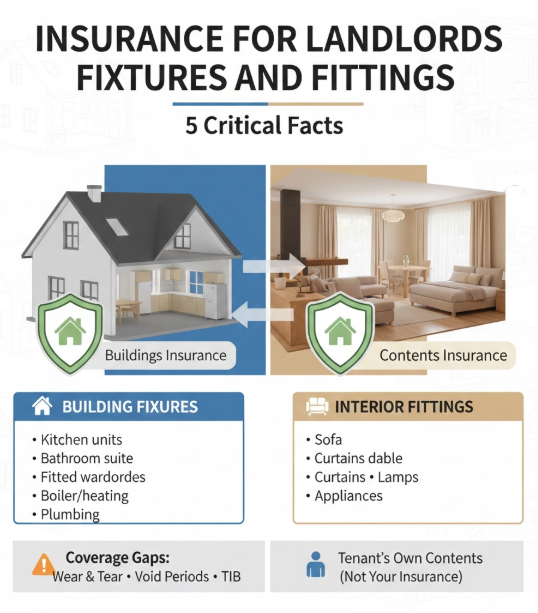
As a property owner, you are typically responsible for insuring the structure of the building and any fixtures that are permanently attached . This includes:
- Built-in kitchen units and worktops
- Bathroom suites including toilets, sinks, and baths
- Central heating systems and boilers
- Electrical wiring and plumbing
- Fitted wardrobes and storage units
Standard buildings insurance policies usually cover these items as they are considered part of the property itself.
Tenant’s Responsibility
Tenants are generally responsible for insuring their own personal belongings, including:
- Free-standing furniture they bring into the property
- Personal electronics and valuables
- Clothing and other personal items
However, the lines can blur when a property is let fully furnished.
Furnished Properties
When you provide furniture and fittings as part of a furnished tenancy, insurance for landlords fixtures and fittings becomes more complex. Items you supply, such as sofas, beds, tables, curtains, and free-standing appliances, are your responsibility to insure .
The Association of British Insurers notes that while buildings insurance is the landlord’s responsibility, you may consider taking out contents insurance to protect your stock and equipment .
Lease Requirements
Many commercial leases explicitly address insurance obligations. Sample lease clauses often require tenants to maintain insurance covering their alterations, trade fixtures, equipment, and personal property, and to name the landlord as an additional insured . Always review your lease agreements to understand specific requirements.
Summary: Responsibility for Insurance
• Landlords insure the building structure and permanent fixtures
• Tenants insure their own personal belongings
• Furnished properties require landlords to insure supplied contents
• Commercial leases often specify insurance obligations
Fact #2: What Standard Buildings Insurance Covers
Understanding what’s included in standard policies helps you identify gaps in insurance for landlords fixtures and fittings that may require additional coverage.
Typically Covered Items
Standard buildings insurance for landlords typically covers:
Coverage Limits and Exclusions
Even when items are covered, there are important limitations to understand:
- Wear and tear: Normal deterioration over time is not covered
- Maintenance issues: Servicing or maintenance costs for appliances are not insured
- Acts of war or terrorism: Standard policies typically exclude terrorism damage, though specialized coverage may be available
Communal Areas
For properties in multi-occupancy buildings, insurance for landlords fixtures and fittings in communal areas may have specific provisions. Many landlords buildings insurance policies provide cover for fixtures and fittings in communal areas, typically with a limit such as £5,000, though this varies by policy .
Valuing Your Fixtures and Fittings
When arranging insurance, you should insure against the cost of rebuilding or replacing the property, not against its sale price or current market value . This is particularly important for fixtures and fittings, where replacement costs may be higher than their depreciated value.
Summary: Buildings Insurance Coverage
• Covers permanent fixtures like kitchens, bathrooms, and service connections
• Excludes wear and tear and routine maintenance
• Communal area coverage may have separate limits
• Insure for replacement cost, not market value
Fact #3: Specialized Coverage for Landlord’s Contents
For furnished properties, standard buildings insurance alone is insufficient. You need dedicated insurance for landlords fixtures and fittings that includes contents coverage.
What Landlord Contents Insurance Covers
Landlord contents insurance specifically covers items you provide as part of a furnished or part-furnished tenancy :
| Item Type | Examples |
|---|---|
| Furniture | Sofas, beds, dining tables, chairs, wardrobes |
| Soft furnishings | Curtains, blinds, carpets, rugs |
| Appliances | Washing machines, dishwashers, fridges, freezers, cookers |
| Lighting | Lamps, light fittings (non-structural) |
| White goods | Standalone appliances not built-in |
Accidental and Malicious Damage Cover
One of the most valuable additions to insurance for landlords fixtures and fittings is accidental and malicious damage protection. This covers:
- Damage caused accidentally by tenants or their guests
- Intentional vandalism or malicious acts
- Breakages that wouldn’t be covered under standard policies
Towergate Insurance notes that malicious damage cover doesn’t necessarily come as standard on all policies, so you should specifically request it when obtaining quotes .
Loss of Rent Cover
If your property becomes uninhabitable due to insured damage to fixtures, fittings, or the building itself, loss of rent cover provides financial protection. Some policies offer up to 36 months of lost rental income .
Flexible Limits
Different properties have different contents values. Quality insurance for landlords fixtures and fittings allows you to choose coverage limits tailored to your specific property’s contents, whether you have basic furnishings or high-end appliances and furniture .
Summary: Contents Insurance Benefits
• Covers furniture, appliances, and soft furnishings you provide
• Accidental and malicious damage protection is essential
• Loss of rent cover provides income protection
• Flexible limits accommodate different property values
Fact #4: Valuation Methods for Fixtures and Fittings Claims
Understanding how insurers value losses is crucial when selecting insurance for landlords fixtures and fittings. The valuation method can significantly impact what you receive after a claim.
Replacement Cost vs. Actual Cash Value
| Valuation Method | How It Works | Best For |
|---|---|---|
| Replacement Cost | Pays the full cost to replace damaged items with new ones of similar kind and quality | Newer properties with modern fixtures |
| Actual Cash Value (Indemnity) | Pays replacement cost minus depreciation based on age and wear | Older properties where depreciation is expected |
Improvements and Betterments
When tenants make improvements to your property, special valuation rules may apply. Tenants’ improvements and betterments (TIB) are fixtures, alterations, installations, or additions that:
- Are made part of the building or structure the tenant occupies but does not own
- The tenant acquired or made at their expense but cannot legally remove
These become part of the real property and are owned by the building owner, creating what insurers call a “use interest” for the tenant .
How TIB Claims Are Valued
If tenants have made improvements and those improvements are damaged, the valuation method is unique:
- If repairs are made promptly, the policy pays actual cash value
- If someone else (like the building owner) pays for repair or replacement, the policy pays nothing
- If repairs are not made promptly, a proportion of the original cost is paid based on the remaining lease term
The calculation works like this:
- Multiply the original cost by the number of days from loss to lease expiration
- Divide that amount by the number of days from installation to lease expiration
This unamortized value approach recognizes that the tenant has only partially realized the value of their investment.
Ordinance or Law Coverage
If building codes have changed since fixtures were installed, ordinance or law coverage becomes essential. The Ordinance or Law Coverage for Tenant’s Interest in Improvements and Betterments endorsement can provide:
- Coverage for undamaged portions of improvements
- Demolition cost coverage
- Increased cost of construction coverage
Summary: Valuation Methods
• Replacement cost provides full coverage for new items
• Actual cash value accounts for depreciation
• Tenant improvements use unamortized value calculations
• Ordinance or law coverage addresses code upgrade costs
Fact #5: Common Coverage Gaps and How to Address Them
Even with comprehensive insurance for landlords fixtures and fittings, gaps can exist that leave you exposed. Identifying and addressing these gaps is essential for complete protection.
Gap 1: Items That Aren’t Clearly Fixtures or Fittings
Some items fall into gray areas. For example, is a built-in washing machine a fixture (covered under buildings) or contents? The answer depends on whether it’s truly integrated or simply placed in a kitchen space.
Solution: Review your policy with your insurer and get written confirmation about how specific items are classified. Consider scheduling high-value items individually.
Gap 2: Underinsurance Due to Rising Replacement Costs
Construction costs and material prices fluctuate. If you haven’t updated your coverage limits recently, you may be underinsured .
Solution: Review your coverage annually and adjust limits based on current replacement costs, not original purchase prices.
Gap 3: Wear and Tear Exclusions
No policy covers normal wear and tear. Over time, carpets wear thin, appliances age, and paint fades. Claims for deterioration without a specific insured event will be denied .
Solution: Budget for regular maintenance and replacement as a normal business expense. Insurance is for sudden and unforeseen damage, not gradual deterioration.
Gap 4: Unoccupied Property Restrictions
Many policies limit coverage when properties are unoccupied for extended periods—typically 30 to 60 consecutive days . During these periods, coverage for certain perils like theft or malicious damage may be restricted.
Solution: If you have void periods, notify your insurer. Some offer specific unoccupied property insurance or extensions.
Gap 5: Tenant’s Personal Property Confusion
Some landlords mistakenly believe their insurance covers tenant belongings. It does not. Tenants are responsible for insuring their own possessions .
Solution: Clearly communicate to tenants that they need their own contents insurance. Include this requirement in your tenancy agreement.
Gap 6: Inadequate Coverage for Communal Areas
If your property has shared spaces like hallways or laundry rooms, standard policies may have low limits for fixtures and fittings in these areas .
Solution: Check your policy limits for communal areas and increase coverage if necessary.
Gap 7: Missing Ordinance or Law Coverage
After damage, you may be required to rebuild to current building codes, which can be significantly more expensive than simply replacing what was there before .
Solution: Add ordinance or law coverage to your policy, especially for older properties.
Summary: Addressing Coverage Gaps
• Clarify classification of borderline items with your insurer
• Update coverage limits annually to reflect current costs
• Budget separately for wear and tear maintenance
• Notify insurers of void periods to maintain coverage
• Educate tenants about their own insurance responsibilities
• Consider ordinance or law coverage for older properties
Frequently Asked Questions
1. What is insurance for landlords fixtures and fittings?
Insurance for landlords fixtures and fittings is specialized coverage protecting items permanently attached to a rental property (like kitchens and bathrooms) as well as contents provided for tenant use (like furniture and appliances). It combines elements of buildings and contents insurance tailored for landlords .
2. Am I legally required to have insurance for fixtures and fittings?
While not required by law, most mortgage lenders will insist on buildings insurance. If you provide furnished accommodation, insuring those contents is strongly recommended as a business protection measure .
3. Does my buildings insurance cover tenant damage to fixtures?
Standard buildings insurance may not automatically cover malicious damage by tenants. You need to specifically request malicious damage cover or ensure your policy includes it .
4. How do I value my fixtures and fittings for insurance purposes?
You should insure for the replacement cost—what it would cost to repair or replace the items with new ones of similar quality. This is different from market value or what you originally paid .
5. What’s the difference between fixtures and fittings in insurance terms?
Fixtures are permanently attached items that become part of the building (kitchens, bathrooms). Fittings are removable items (furniture, curtains). Buildings insurance typically covers fixtures, while contents insurance covers fittings .
6. Can tenants make claims under my insurance policy?
No. Tenants cannot claim under your policy for their belongings. They need their own contents insurance. Your policy only covers your property and items you provide .
7. What happens if my property is unoccupied for several months?
Many policies restrict coverage after 30-60 days of vacancy. You should notify your insurer during void periods and may need specific unoccupied property insurance .
8. Does insurance cover wear and tear on fixtures and fittings?
No. Insurance covers sudden and unforeseen damage from specific perils like fire, flood, or theft. Normal wear and tear, gradual deterioration, and maintenance issues are not covered .
9. How do claims for tenant improvements work?
If a tenant has made improvements at their expense and those improvements are damaged, claims may be valued based on unamortized cost—the portion of the original cost representing the remaining lease term .
10. What endorsements should I consider for comprehensive coverage?
Consider accidental and malicious damage cover, ordinance or law coverage, loss of rent insurance, and increased limits for communal area fixtures and fittings .
Summary: Insurance for Landlords Fixtures and Fittings
Protecting your rental property investment requires understanding the unique aspects of insurance for landlords fixtures and fittings.
Key Takeaways
- Fixtures vs. fittings matters: Fixtures are permanently attached and typically covered under buildings insurance; fittings require contents coverage. Proper classification ensures you’re not underinsured .
- Responsibility varies: Landlords insure the building structure and any contents they provide. Tenants are responsible for their own belongings. Furnished properties require landlord contents insurance .
- Standard policies have limits: Buildings insurance covers permanent fixtures but excludes wear and tear, routine maintenance, and may have sub-limits for communal areas .
- Specialized contents coverage is essential: For furnished properties, landlord contents insurance protects furniture, appliances, and soft furnishings. Adding accidental and malicious damage cover is highly recommended .
- Valuation methods impact claims: Replacement cost coverage provides better protection than actual cash value, which accounts for depreciation. Tenant improvements use unique unamortized value calculations .
- Coverage gaps exist: Common gaps include underinsurance, unoccupied property restrictions, missing ordinance or law coverage, and confusion over tenant belongings .
- Review policies annually: Replacement costs change, properties change, and your coverage needs evolve. Annual reviews with your insurer ensure you maintain adequate protection.
The most important takeaway? Insurance for landlords fixtures and fittings requires a comprehensive approach that addresses both the permanent fixtures of your property and any contents you provide. Work with an insurer who understands landlord needs, read your policy carefully, and ensure you have appropriate coverage for your specific rental situation.
Consult with a specialist landlord insurance broker who can help you navigate these complexities and find coverage tailored to your property portfolio.
Conclusion
The distinction between fixtures and fittings isn’t just legal terminology—it has real financial implications for landlords when damage occurs. Understanding insurance for landlords fixtures and fittings helps ensure that when the unexpected happens, you’re properly covered.
Remember that your buildings insurance protects the permanent fixtures that make your property habitable: the kitchen that took months to install, the bathroom suite that completes the space, the heating system that keeps tenants warm . But if you’ve furnished the property, those sofas, beds, and appliances need their own protection under a landlord contents policy .
The rental market continues to evolve, with more landlords offering furnished accommodation to attract tenants. This trend makes comprehensive insurance for landlords fixtures and fittings more important than ever. Don’t assume your buildings policy covers everything—verify it.
Take these practical steps today:
- Create a detailed inventory of all fixtures and fittings, with photographs and estimated replacement costs
- Review your current policies to understand exactly what’s covered and any exclusions
- Discuss coverage gaps with your insurer or broker
- Update your tenancy agreements to clearly communicate insurance responsibilities to tenants
- Schedule annual reviews to adjust coverage as property values and contents change
Your rental property is your investment and your livelihood. Protecting it with appropriate insurance for landlords fixtures and fittings gives you peace of mind and financial security, allowing you to focus on what matters: providing quality housing for your tenants.
Consult with a specialist landlord insurance provider who can assess your specific needs and recommend coverage that leaves no gaps. Your property portfolio deserves nothing less.
References
- Legislation.gov.uk. (1980). Housing Act 1980 – Section 81: Tenant’s improvements. https://www.legislation.gov.uk/ukpga/1980/51/section/81/enacted
- IRMI. (2024). Tenants’ Improvements and Betterments—Important Considerations. https://www.irmi.com/articles/expert-commentary/tenants-improvements-and-betterments-important-considerations
- Law Insider. (2025). Tenant’s Personal Property and Fixtures Clause Samples. https://www.lawinsider.com/clause/tenants-personal-property-and-fixtures
- Association of British Insurers. Commercial property insurance. https://www.abi.org.uk/products-and-issues/choosing-the-right-insurance/business-insurance/commercial-property-insurance/
- Legislation.gov.uk. Landlord and Tenant Act 1927. https://www.legislation.gov.uk/ukpga/Geo5/17-18/36/contents
- Indequity. Business Insurance – Probiz Buildings. https://indequity.com/probiz-buildings/
- Association of British Insurers. Environmental liability insurance. https://www.abi.org.uk/products-and-issues/choosing-the-right-insurance/business-insurance/liability-insurance/environmental-liability-insurance/
- Legislation.gov.uk. Provisions as to Landlord and Tenant Act 1927. https://www.legislation.gov.uk/ukpga/Geo6/14-15/65/section/33/2004-10-01
- Towergate Insurance. Landlord Contents Insurance. https://www.towergateinsurance.co.uk/landlords/landlord-contents-insurance
- Law Insider. (2026). Tenant’s Property Insurance Sample Clauses. https://www.lawinsider.com/clause/tenants-property-insurance
Disclaimer:
The content provided is for informational purposes only and does not constitute legal or insurance advice. While efforts are made to ensure accuracy, no guarantees are given regarding completeness or reliability. Insurance policies, laws, and regulations vary by jurisdiction and may change over time. Any action you take upon the information is strictly at your own risk. We recommend consulting with a qualified insurance professional and legal advisor for advice regarding your specific situation.