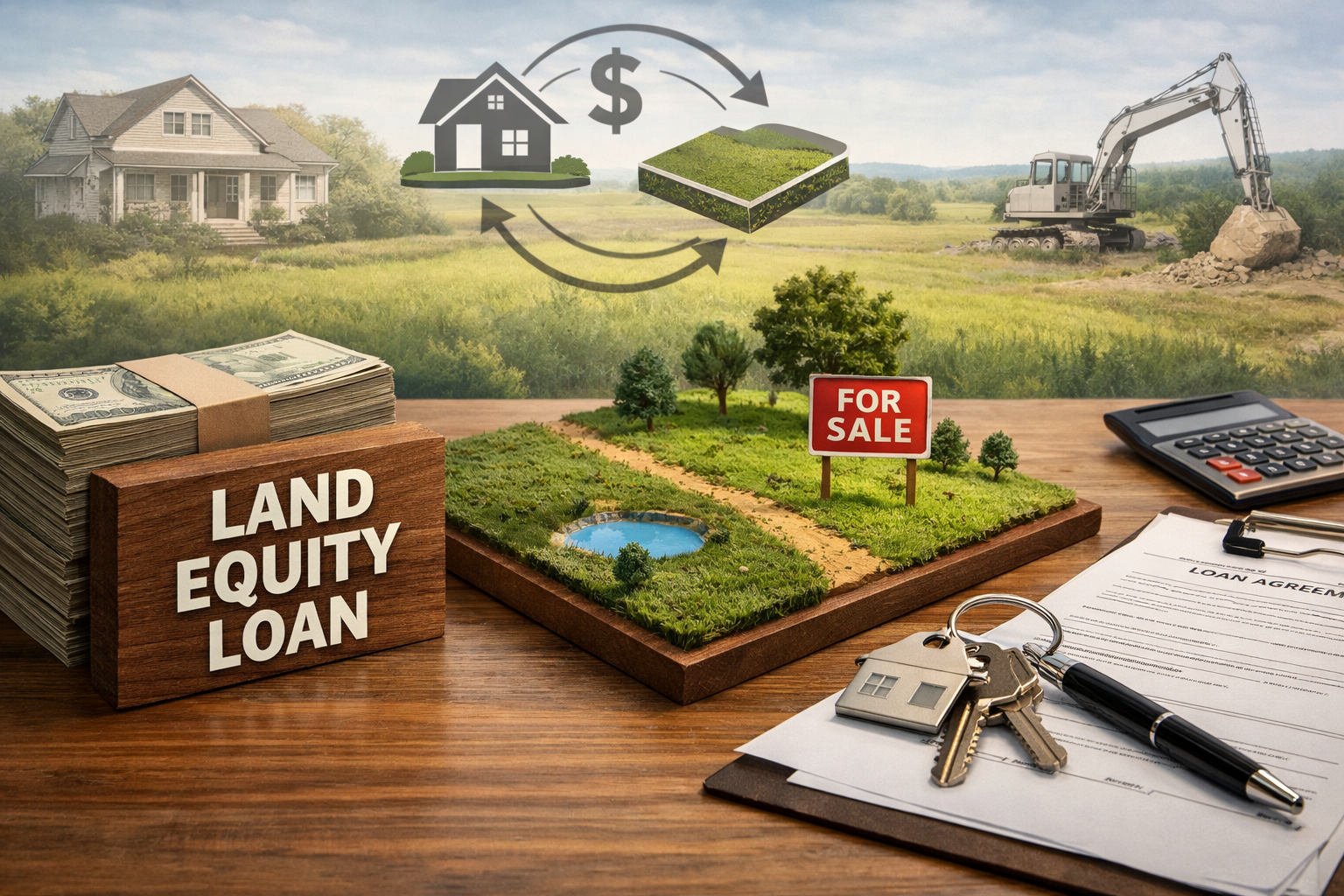
A land equity loan is a secured financing product where property owners borrow against the market value of their land. Lenders assess land appraisal value, ownership documentation, and credit profile before approval. These loans are commonly used for development, investment, or liquidity needs.
Introduction to Land Equity Loan
A land equity loan allows property owners to unlock the financial value stored in real estate assets. Unlike unsecured borrowing, this financing method uses land ownership as collateral security.
Financial institutions evaluate the land’s market price before approving credit. The loan amount depends on the equity portion, not the total land value. Equity represents the difference between current appraisal value and outstanding liabilities.
According to modern secured lending practice, collateral-backed credit products usually provide better borrowing capacity than personal loans because risk exposure is reduced for lenders.
Organizations such as the Consumer Financial Protection Bureau emphasize responsible borrowing and repayment transparency when using asset-backed financing.
Borrowers often use land equity financing for construction preparation, business expansion, or emergency liquidity access.
How Land Equity Loan Works
The mechanism of a land equity loan follows a structured asset valuation model.
Step 1: Land Appraisal
Lenders determine fair market price using professional valuation methods.
- Location advantage
- Soil and development potential
- Legal zoning classification
- Market demand trends
The appraisal stage is important because it directly influences the loan-to-value ratio.
Step 2: Equity Calculation
Equity is calculated as:
Equity = Current Land Market Value – Existing Liens or Debt
If land value increases over time, borrowing potential may also increase.
This principle is widely used in asset-backed lending systems.
Step 3: Risk Assessment
Credit risk models evaluate borrower repayment ability.
Financial systems often reference scoring methodologies similar to guidelines influenced by the lending frameworks of the Federal Reserve System.
Types of Land Equity Financing
Land equity loan products vary depending on property classification.
1. Vacant Land Equity Loan
Vacant plots are considered higher risk because they generate no immediate income.
Lenders may require:
- Higher credit score
- Lower loan-to-value ratio
- Strong financial history
2. Agricultural Land Collateral Loan
Agricultural properties may qualify under specialized rural financing programs.
Productive farmland is sometimes valued based on harvest output potential.
3. Residential Plot Equity Loan
Residential land is generally easier to finance because development probability is higher.
| Loan Type | Approval Difficulty | Typical LTV Ratio |
|---|---|---|
| Vacant Land | High | 50% or lower |
| Agricultural Land | Medium | 60% approx |
| Residential Plot | Medium-Low | 60–75% |
Eligibility Requirements for Land Equity Loan
Ownership Documentation
Borrowers must prove legal land ownership.
Required documents may include:
- Title deed verification
- Property registration certificate
- Tax payment history
Credit Score Influence
Lenders often evaluate credit history.
Traditional underwriting systems follow risk modeling similar to practices used in the mortgage industry.
| Credit Range | Approval Probability |
|---|---|
| 750+ | High |
| 650–749 | Moderate |
| Below 650 | Difficult but possible |
Based on consumer lending behavior studies, consistent repayment history is more important than single high income spikes.
Income Stability and Debt Ratio
Financial advisors recommend maintaining:
- Debt-to-income ratio below 40%
The Fannie Mae underwriting model also promotes sustainable repayment capacity.
Interest Rate Structure of Land Equity Loan
Interest rates depend on risk exposure.
Risk pricing components include:
- Land liquidity level
- Borrower credit quality
- Economic conditions
- Regional property market trends
Land equity loan interest rates are usually higher than home equity financing because land is less liquid than developed property.
Simple Interest vs Amortized Interest
Many private lenders apply simplified interest calculation.
Borrowers should check whether payments are:
- Interest-only monthly payments
- Principal repayment at maturity
Traditional banking systems prefer amortization schedules because they reduce default probability.
Loan-to-Value Ratio Explained
The loan-to-value ratio (LTV) is a critical approval factor.
| LTV Level | Meaning |
|---|---|
| 40–50% | Conservative lending |
| 60% | Balanced risk |
| 75%+ | High risk exposure |
Higher LTV means higher borrower leverage but increases lender risk.
Statistical lending models show that subprime collateral loans have higher default probability when leverage exceeds recommended thresholds.
People Also Ask (PAA)
How does land equity loan work?
A land equity loan works by using property land as collateral. Lenders assess appraisal value, credit score, and repayment capacity before approving funding.
Can you borrow money against land only?
Yes. Borrowing against land only is possible if the land has clear ownership title and acceptable market valuation.
What is the interest rate on land equity loans?
Interest rates vary by region, credit score, and lender policy but are typically higher than home equity loans because land is less liquid collateral.
Is land equity loan risky?
Risk exists because:
- Land resale may take time
- Market value can fluctuate
- Default may lead to collateral seizure
Advantages of Land Equity Loan
✔ Higher Borrowing Capacity
Asset-backed lending allows larger credit limits.
✔ Flexible Usage
Funds can be used for:
- Construction projects
- Business investment
- Debt consolidation
- Emergency financial support
✔ Competitive Approval Probability
Even borrowers with moderate credit profiles may qualify.
Disadvantages of Land Equity Loan
| Risk Factor | Explanation |
|---|---|
| Collateral loss | Default may lead to asset seizure |
| Higher interest cost | Compared to mortgage loans |
| Appraisal dependency | Market fluctuation risk |
Responsible borrowing is recommended by financial consumer protection organizations.
According to industry lending behavior data, maintaining repayment discipline significantly reduces long-term financial stress.
Summary
- Secured asset-based lending product
- Uses land value as collateral
- Approval depends on appraisal and credit score
- Commonly used for development or liquidity
- Interest rates vary by risk exposure
Internal Summary Box
Key Takeaways
- Land equity loan unlocks property financial value
- Loan amount depends on appraisal equity
- Credit history and ownership proof are critical
- Risk increases with higher leverage
- Always check repayment structure
Land Equity Loan Application, Risks, and Financial Strategy
A land equity loan is a secured lending instrument that allows property owners to convert land asset value into usable capital. Unlike unsecured credit, this financing method reduces lender exposure because the loan is backed by real estate collateral.
Financial markets categorize land-based borrowing as asset-backed lending. According to modern credit risk management models used in global banking, collateralized lending typically shows lower default probability compared to unsecured consumer loans.
Borrowers usually apply for a land equity loan when they need funds for investment, development projects, or emergency liquidity. However, understanding repayment obligations is essential before signing any credit agreement.
Land Equity Loan Application Process
Applying for a land equity loan involves multiple verification layers designed to protect both lender and borrower.
Ownership Verification Stage
Legal ownership is the primary requirement.
Applicants must present authenticated property documentation including:
- Registered land title certificate
- Government land record verification
- Tax payment compliance records
Title disputes are one of the major rejection causes in collateral lending systems.
Financial institutions follow strict legal validation frameworks similar to regulatory expectations promoted by the Federal Reserve System.
also read: https://fundbulletins.com/hard-money-loan-for-primary-residence/
Land Valuation and Appraisal Methodology
Property valuation is the most important determinant in a land equity loan approval decision.
Professional appraisers evaluate:
- Geographic location advantages
- Transportation connectivity
- Future development probability
- Regional market demand
- Infrastructure expansion projects
Urban land close to commercial zones usually receives higher valuation.
The valuation process reduces asymmetric information risk between borrower and lender.
Modern banking systems reference risk assessment principles aligned with guidance from the Federal Deposit Insurance Corporation.
Creditworthiness and Financial Behavior Analysis
Credit evaluation is used to predict repayment probability.
Important variables include:
- Historical loan repayment performance
- Existing debt obligations
- Employment stability
- Monthly cash flow strength
The Consumer Financial Protection Bureau emphasizes transparent income declaration when applying for secured credit products.
Statistical lending research shows borrowers with consistent repayment history are more likely to obtain favorable interest pricing.
Loan-to-Value Ratio and Borrowing Capacity
Loan-to-value ratio (LTV) is a central risk control mechanism in a land equity loan structure.
| LTV Level | Lending Risk | Borrower Advantage |
|---|---|---|
| 40–50% | Low risk | Lower interest cost |
| 50–65% | Balanced | Standard approval |
| 65–75% | Higher risk | Larger loan amount |
Higher LTV increases leverage but also increases repayment pressure.
Economic modeling suggests maintaining conservative leverage improves long-term financial stability.
Interest Rate Determination Factors (Expanded Analysis)
Interest rates for a land equity loan are influenced by a combination of macroeconomic monetary policy signals, borrower financial behavior, and collateral risk evaluation models. Lending institutions use predictive pricing strategies to maintain profitability while minimizing default exposure.
Central Bank Benchmark Influence
Monetary policy directly affects borrowing cost structure.
Commercial lenders usually align their base lending rate with benchmark interest rates established by national central banking authorities. When policy rates increase, commercial credit cost also rises.
For example, tightening monetary policy is commonly used to control inflationary pressure. Higher interest rates reduce excessive borrowing and slow speculative asset demand.
The framework used by the Federal Reserve System influences global capital liquidity patterns. Even private lending institutions indirectly adjust pricing models based on macroeconomic rate movements.
Property Market Liquidity Conditions
Liquidity represents how quickly land assets can be converted into cash without significant price reduction.
Urban land located near commercial infrastructure usually has higher liquidity than rural or undeveloped land.
Key liquidity indicators include:
- Population growth rate
- Commercial development activity
- Transportation accessibility
- Industrial zone expansion
- Future zoning approval probability
When liquidity is high, lenders may offer relatively lower interest margins because collateral recovery probability is stronger.
Borrower Credit Quality Assessment
Credit scoring remains one of the strongest predictors of repayment performance in a land equity loan structure.
Financial institutions evaluate:
- Historical repayment reliability
- Existing debt exposure
- Employment continuity
- Income verification strength
The consumer protection framework promoted by the Consumer Financial Protection Bureau encourages lenders to avoid predatory pricing and maintain transparent contract disclosure.
Borrowers with high credit scores are statistically associated with lower default probability, allowing them to negotiate better interest conditions.
Collateral Development Potential
Land development possibility significantly influences lending risk evaluation.
Land that can potentially support:
- Residential construction
- Commercial business expansion
- Agricultural productivity
- Industrial facility development
is considered more valuable collateral.
Future economic productivity increases asset recovery probability if repayment failure occurs.
Mortgage financing principles adopted by the Fannie Mae emphasize sustainable property valuation modeling.
Loan Duration and Term Structure
Loan duration is another critical pricing variable.
Short-term loans usually have:
- Lower cumulative risk exposure
- Higher monthly installment pressure
Long-term loans provide:
- Lower installment burden
- Higher total interest cost
Private financial institutions sometimes use risk-adjusted term pricing where longer maturity loans carry slightly higher interest spreads.
Recovery Cost and Default Probability Modeling
Recovery cost analysis plays a major role in secured lending pricing.
If default occurs, lenders may incur expenses such as:
- Legal enforcement fees
- Property auction management
- Transportation and storage cost
- Marketing and resale commission
Economic risk theory states that expected recovery loss must be included in interest margin calculation.
Market Risk and Economic Cycle Influence
Macroeconomic cycles affect land valuation stability.
During economic expansion:
- Property demand increases
- Collateral value may appreciate
During recession:
- Asset liquidity may decline
- Default probability may increase
Financial risk management institutions such as the Bank for International Settlements study systemic credit stability patterns.
Borrower Leverage Behavior
High leverage borrowing increases financial vulnerability.
Experts recommend maintaining conservative borrowing limits.
Responsible credit management improves long-term financial security and supports sustainable asset ownership.
Summary Insight
- Interest rates in a land equity loan are not fixed; they are dynamically determined.
- Monetary policy, property market conditions, credit behavior, and collateral quality are primary pricing drivers.
- Strategic financial planning can help borrowers obtain more favorable financing terms.
Interest Payment Models
Interest-Only Structure
Borrowers pay only interest monthly.
Advantages:
- Lower short-term financial burden
- Suitable for construction investment
Disadvantages:
- Principal balance remains unchanged
- Long-term cost may increase
Amortized Payment Structure
Each installment reduces principal.
Advantages:
- Gradual debt reduction
- Predictable financial planning
Most regulated financial institutions prefer amortization.
Responsible Borrowing Strategy for Land Equity Loan
Financial sustainability requires disciplined credit usage.
Maintain Safe Debt Exposure
Recommended financial health indicators:
- Debt-to-income ratio below 40%
- Emergency savings reserve
- Stable income source
According to lending behavior studies, excessive leverage is a major predictor of default risk.
Strategic repayment discipline transforms how a land equity loan contributes to long-term wealth development rather than short-term consumption.
Exit Strategy Planning
Borrowers should define repayment sources before obtaining credit.
Common repayment channels include:
- Real estate development income
- Business expansion profits
- Investment returns
- Asset liquidation if necessary
Professional financial advisors often recommend exit strategy evaluation.
Risks of Land Equity Loan (Expanded Risk Analysis)
While a land equity loan provides access to asset-backed financing, it also introduces financial and legal obligations that borrowers must carefully evaluate before signing any credit agreement.
Risk management is a fundamental principle of secured lending because collateralized loans directly involve property ownership security.
Financial risk researchers indicate that default-related asset recovery processes may create long-term financial and legal consequences for borrowers.
Collateral Loss Risk (Detailed Explanation)
Collateral loss risk is the primary concern in a land equity loan agreement.
If repayment obligations are not fulfilled according to contract terms, lenders have the legal right to initiate recovery procedures. These procedures are generally defined within the loan agreement and local property law regulations.
Collateral enforcement typically follows structured legal stages:
- Formal payment reminder issuance
- Legal notification delivery
- Contract default declaration
- Asset liquidation authorization
Legal enforcement standards are often aligned with consumer credit protection policies recommended by the Consumer Financial Protection Bureau.
Borrowers should carefully review foreclosure clauses before finalizing loan contracts.
Property Auction and Asset Liquidation Process
When default occurs, lenders may recover outstanding debt through property sale mechanisms.
Auction-based recovery is commonly used because it provides:
- Transparent price discovery
- Faster liquidity realization
- Reduced administrative cost
However, auction markets may not always reflect full property market value.
Forced sale conditions sometimes lead to price discounting compared to normal real estate transactions.
The recovery pricing mechanism must also consider operational expense coverage including legal processing and administrative handling.
Recovery Cost Structure
Recovery cost refers to total expenditure incurred during collateral enforcement and resale operations.
Major cost components include:
- Legal documentation processing fees
- Property maintenance during recovery period
- Auction marketing expenses
- Transportation or inspection services
- Third-party administrative charges
Economic lending models require these costs to be included in expected risk margin pricing.
Market Value Depreciation Risk
Land market value may fluctuate due to external economic forces.
Key influencing factors include:
- Government infrastructure policy changes
- Urban expansion planning
- Environmental zoning regulations
- Industrial development movement
- Population migration trends
During economic slowdown periods, land resale may require longer marketing time.
The financial stability framework monitored by the Federal Reserve System highlights the importance of collateral liquidity in credit risk evaluation.
Interest Accumulation and Debt Burden Risk
If borrowers choose interest-only repayment structures, principal balance reduction may be slow.
Long-term interest accumulation can increase total repayment cost.
Borrowers should calculate:
- Total interest expense over loan life
- Early settlement penalty conditions
- Installment affordability under income variation scenarios
Financial planners often recommend reviewing amortization schedules before accepting a land equity loan.
Legal Ownership Dispute Risk
Property title disputes represent significant risk exposure.
Common causes include:
- Family inheritance conflict
- Registration record errors
- Boundary demarcation uncertainty
- Historical ownership claims
Clear land title verification is essential before collateralization.
Economic Shock Sensitivity
Asset-backed loans are sensitive to macroeconomic shocks.
During financial crises:
- Property demand may decline
- Asset liquidity may reduce
- Default probability may increase
International financial organizations such as the Bank for International Settlements analyze systemic credit vulnerability during economic downturns.
Psychological Financial Pressure Risk
Borrowing against land asset ownership may create psychological financial pressure for some borrowers.
This risk is often underestimated but can influence:
- Business decision behavior
- Investment confidence
- Long-term financial planning
Responsible credit counseling is recommended.
Risk Mitigation Strategies
Borrowers can reduce financial exposure by following professional guidelines:
| Strategy | Description |
|---|---|
| Conservative LTV selection | Avoid maximum leverage borrowing |
| Fixed interest preference | Protect against rate volatility |
| Emergency repayment reserve | Maintain backup liquidity |
| Contract review | Understand penalty structure |
| Market research | Analyze land price trend |
Summary Insight
- Collateral loss is the primary risk in a land equity loan.
- Recovery cost and legal enforcement procedures affect lender pricing.
- Market volatility and liquidity factors influence financial safety.
- Responsible borrowing discipline significantly reduces default probability.
Market Price Volatility
Land market value may fluctuate due to:
- Economic recession cycles
- Government zoning policy changes
- Infrastructure development projects
Asset depreciation increases financial exposure.
Liquidity Constraint
Land assets are less liquid than residential housing.
Selling land quickly may require price reduction.
Asset liquidity risk is one reason interest rates are typically higher for a land equity loan.
Responsible Application Checklist
| Step | Action |
|---|---|
| Credit Score Check | Maintain healthy rating |
| Document Preparation | Title deed + tax records |
| LTV Selection | Prefer conservative leverage |
| Interest Comparison | Evaluate multiple lenders |
| Repayment Forecast | Calculate monthly obligation |
According to consumer lending research, borrowers who follow structured preparation steps have higher approval success rates.
Land Equity Loan vs Other Credit Products
| Feature | Land Equity Loan | Home Equity Loan | Personal Loan |
|---|---|---|---|
| Collateral | Land | Residential building | None |
| Approval Speed | Medium | Medium | Fast |
| Interest Rate | Higher | Moderate | High |
| Risk Exposure | Medium-High | Medium | Hig |
Explanation
- Secured property-based lending system
- Uses land value as repayment security
- Requires appraisal verification
- Interest rate depends on credit risk
- Suitable for development or investment capital
Frequently Asked Questions
What is a land equity loan used for?
It is used for construction, investment, business funding, or emergency liquidity.
Can I get a land equity loan with bad credit?
Private lenders may approve but usually charge higher interest rates.
How fast is approval?
Approval time ranges from a few days to several weeks depending on verification complexity.
Is agricultural land acceptable?
Yes, if ownership and productivity potential are verified.
Why is land equity loan interest higher?
Because land collateral is less liquid and recovery cost risk is higher.
Short Summary
- Land equity loan converts land asset value into capital
- Approval depends on appraisal, credit, and legal ownership
- Risk management and repayment discipline are essential
References
https://www.consumerfinance.gov/
https://www.fdic.gov/
https://fred.stlouisfed.org/
https://www.fanniemae.com/
https://www.investopedia.com/
https://www.usa.gov/real-estate
https://www.bis.org/ (Bank for International Settlements)
Disclaimer:
The content provided is for informational purposes only and does not constitute financial, investment, legal, or tax advice. While efforts are made to ensure accuracy, no guarantees are given regarding completeness or reliability. Any action you take upon the information is strictly at your own risk. We recommend consulting a licensed financial advisor or professional before making financial decisions