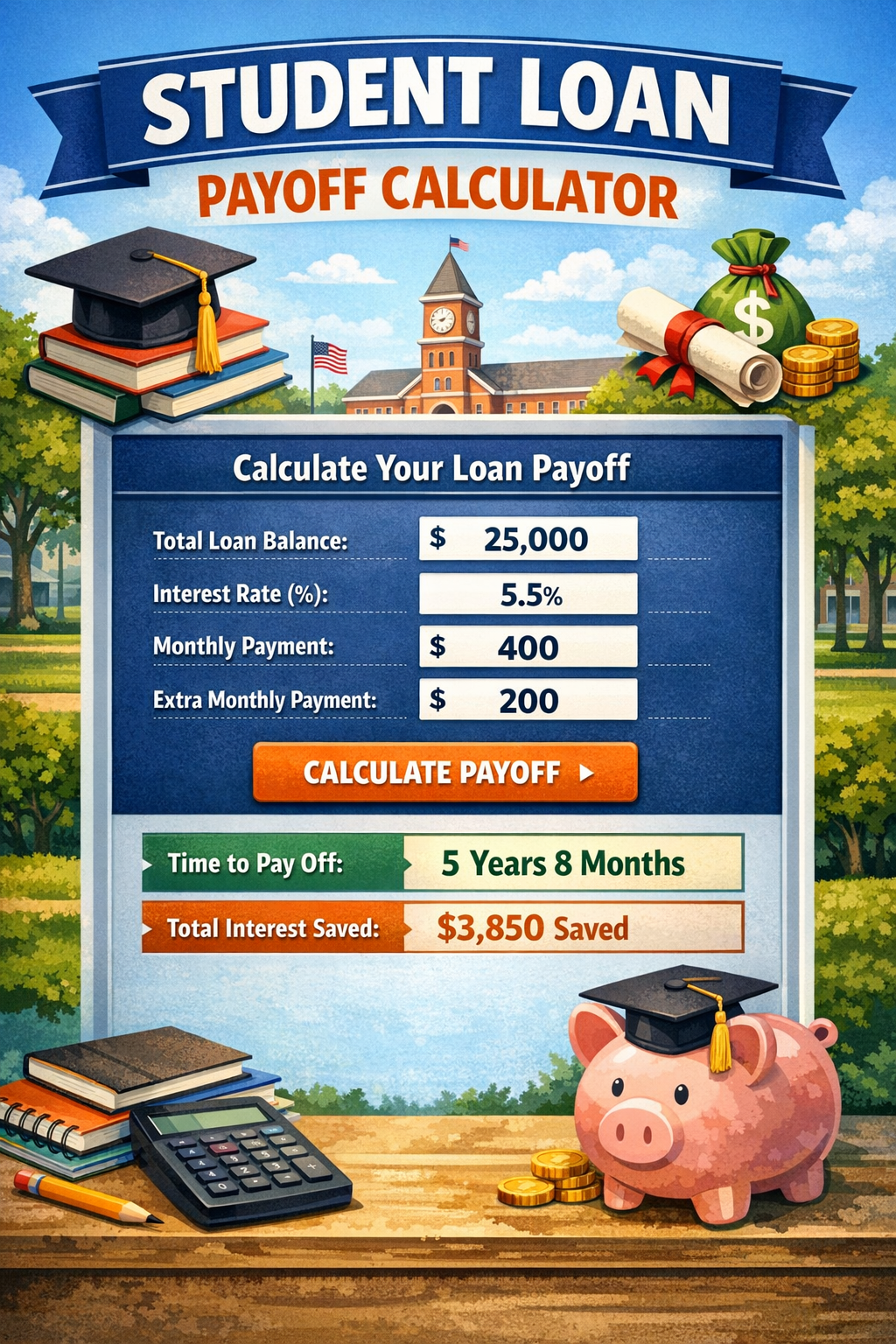
A calculator for student loan payoff is a financial tool that estimates how long it will take to repay student debt based on loan balance, interest rate, and monthly payment. It projects total interest costs, payoff dates, and savings from extra payments to support informed repayment decisions.
A calculator for student loan payoff helps borrowers estimate repayment timelines and total interest expenses using amortization formulas. It is commonly used for both federal and private education loans to evaluate financial strategies before committing to higher payments or refinancing.
According to industry-standard amortization practices, loan repayment schedules allocate a larger portion of early payments toward interest rather than principal. This tool models that allocation to provide accurate payoff projections.
Core objectives:
- Estimate exact payoff date
- Calculate total interest paid
- Compare repayment strategies
- Forecast interest savings from extra payments
- Evaluate refinancing impact
Key Inputs Required
A reliable calculator for student loan payoff requires accurate loan data. Even minor input errors can significantly change projected outcomes.
Required Variables
| Input Variable | Description | Why It Matters |
|---|---|---|
| Loan Balance | Current outstanding principal | Determines base interest calculation |
| Interest Rate (APR) | Annual percentage rate | Drives cost of borrowing |
| Monthly Payment | Fixed or estimated payment | Controls payoff speed |
| Loan Term | Original repayment length | Impacts amortization structure |
| Extra Payment | Additional principal payments | Reduces total interest |
Outputs Generated
Once inputs are entered, a calculator for student loan payoff generates several financial projections:
| Output | What It Shows |
|---|---|
| Payoff Date | Month and year debt is eliminated |
| Total Interest Paid | Lifetime borrowing cost |
| Interest Savings | Savings from extra payments |
| Amortization Schedule | Payment-by-payment breakdown |
| Remaining Balance Over Time | Debt trajectory |
These projections are based on amortization models commonly used by financial institutions and loan servicers.
How a Calculator for Student Loan Payoff Works (Behind the Math)
A calculator for student loan payoff uses standardized amortization formulas applied across consumer lending.
The Amortization Formula Explained
The standard loan payment formula:M=P(1+r)n−1r(1+r)n
Where:
- M = Monthly payment
- P = Principal balance
- r = Monthly interest rate
- n = Total number of payments
(According to standard banking amortization models.)
This formula determines fixed monthly payments for installment loans such as student loans.
Simple vs Compound Interest Impact
Federal student loans use daily interest accrual, meaning interest accumulates daily based on outstanding principal.
Private loans may use different compounding structures depending on lender terms.
Key principle:
Interest is calculated on principal plus any capitalized interest.
Fixed vs Variable Interest Rates
| Loan Type | Rate Behavior | Risk Level |
|---|---|---|
| Fixed Rate | Remains constant | Predictable |
| Variable Rate | Fluctuates with market index | Payment uncertainty |
A calculator for student loan payoff must account for rate stability assumptions when modeling future payments.
Types of Student Loan Repayment Plans
Repayment plan selection significantly affects projections in a calculator for student loan payoff. Standard Repayment Plan
- 10-year fixed term
- Highest monthly payment
- Lowest total interest cost
- Default federal repayment structure
Graduated Repayment Plan
- Payments start lower
- Increase every two years
- 10-year term
- Higher total interest
Income-Driven Repayment (IDR) Plans
Income-driven plans cap payments based on discretionary income.
Key programs include:
- SAVE Plan
- PAYE (Pay As You Earn)
- REPAYE
- IBR (Income-Based Repayment)
According to the U.S. Department of Education, IDR plans extend repayment to 20–25 years, increasing total interest paid but reducing monthly burden.
Refinancing and Private Loan Structures
Refinancing replaces existing loans with a new private loan at a potentially lower interest rate.
Impacts modeled in a calculator for student loan payoff:
- Reduced interest rate
- New repayment term
- Loss of federal protections
- Modified amortization structure
Repayment Plan Comparison Table
| Plan Type | Term Length | Monthly Payment | Total Interest | Flexibility |
|---|---|---|---|---|
| Standard | 10 Years | High | Lowest | Low |
| Graduated | 10 Years | Increasing | Moderate | Medium |
| IDR | 20–25 Years | Income-Based | Highest | High |
| Refinanced | 5–20 Years | Variable | Depends on Rate | Medium |
Benefits of Using a Calculator for Student Loan Payoff
A structured calculator for student loan payoff provides measurable financial advantages.
Interest Savings Forecasting
Borrowers can model scenarios such as:
- Adding $100–$300 monthly
- Making annual lump-sum payments
- Switching repayment plans
Even modest extra payments significantly reduce lifetime interest.
Budget Planning Accuracy
A calculator for student loan payoff aligns repayment timelines with:
- Retirement planning
- Home purchase goals
- Debt-to-income ratio improvements
- Emergency fund strategies
(According to consumer financial planning standards.)
Financial Goal Alignment
Payoff projections allow borrowers to:
- Set realistic debt-free dates
- Evaluate opportunity cost
- Compare investing vs early payoff
Pros and Cons Summary
Advantages
- Clear payoff timeline
- Interest cost transparency
- Strategy comparison
- Better budgeting accuracy
Limitations
- Assumes consistent payments
- Cannot predict future rate changes
- IDR forgiveness complexity not fully modeled
Extra Payments Strategy Analysis
Adding principal payments is one of the most powerful variables in a calculator for student loan payoff.
Debt Avalanche Method
- Prioritizes highest interest rate loan
- Minimizes total interest
- Mathematically optimal
Debt Snowball Method
- Pays smallest balance first
- Psychological motivation advantage
- May cost more in interest
Biweekly Payment Strategy
Instead of 12 payments per year, borrowers make 26 half-payments.
Result:
- One extra full payment annually
- Faster principal reduction
Lump-Sum Payment Strategy
Applying tax refunds, bonuses, or windfalls directly to principal reduces interest accrual immediately.
Strategy Comparison Table
| Strategy | Interest Savings | Psychological Benefit | Complexity |
|---|---|---|---|
| Avalanche | Highest | Moderate | Low |
| Snowball | Moderate | High | Low |
| Biweekly | Moderate | Low | Low |
| Lump-Sum | Variable | Low | Low |
Federal vs Private Student Loans — Calculation Differences
A calculator for student loan payoff must account for structural differences between federal and private loans.
Subsidized vs Unsubsidized Loans
Subsidized loans do not accrue interest during in-school periods.
Unsubsidized loans accrue interest immediately.
Grace Period Interest Impact
Federal loans often include a six-month grace period.
Interest accrual during this time increases total payoff cost if unpaid.
Capitalization Rules
Interest capitalization occurs when unpaid interest is added to principal.
This increases long-term repayment cost.
Federal vs Private Loan Differences
| Feature | Federal Loan | Private Loan |
|---|---|---|
| Interest Subsidy | Possible | No |
| IDR Eligibility | Yes | No |
| Forgiveness Programs | Yes | Rare |
| Variable Rates | Limited | Common |
| Capitalization Events | Structured | Lender-Defined |
Key Takeaways
- A calculator for student loan payoff models amortization using standardized formulas.
- Extra payments reduce both payoff time and total interest.
- Repayment plan selection dramatically affects long-term cost.
- Federal and private loans follow different calculation rules.
- Accurate inputs determine reliable projections.
How to Use a Calculator for Student Loan Payoff (Step-by-Step Guide)
Using a calculator for student loan payoff correctly requires structured data input, consistent assumptions, and scenario testing. Accuracy depends entirely on realistic financial variables. Even small errors in balance, APR, or projected extra payments can materially distort payoff timelines and total interest calculations.
Financial modeling tools are deterministic. They produce outputs based strictly on the numbers entered. If assumptions are unrealistic, projections will also be unrealistic.
also read: https://fundbulletins.com/assumable-va-loan/
Why Structured Data Input Matters
A calculator for student loan payoff applies amortization formulas that assume:
- Fixed payment consistency
- Accurate interest rate input
- No missed payments
- No unexpected capitalization events
If borrowers enter rounded balances, outdated rates, or estimated payments, the resulting payoff schedule may deviate significantly from actual loan behavior.
For example:
| Input Error | Potential Impact |
|---|---|
| Incorrect APR by 0.5% | Thousands in projected interest variance |
| Ignoring capitalized interest | Underestimated payoff duration |
| Assuming constant income under IDR | Inaccurate long-term interest estimate |
(According to standard loan amortization modeling principles.)
Realistic Assumptions Are Critical
When using a calculator for student loan payoff, assumptions should reflect probable financial conditions rather than optimistic projections.
Areas requiring conservative modeling:
- Income Stability
If income fluctuates, do not assume consistent extra payments for 10+ years. - Variable Interest Rates
For private loans tied to market indices, test higher-rate scenarios. - Emergency Expenses
Temporary payment reductions should be factored into long-term planning. - Inflation and Cost of Living Increases
These may affect disposable income available for acceleration strategies.
Financial planning standards recommend running base-case, moderate, and stress-test scenarios to improve forecast reliability.
Scenario Testing Framework
To maximize the usefulness of a calculator for student loan payoff, borrowers should run at least three structured simulations.
1. Base Case Scenario
- Current payment only
- No extra payments
- Fixed interest assumption
Purpose: Establish repayment baseline.
2. Accelerated Payment Scenario
- Add $100–$300 monthly
- Maintain conservative budgeting assumption
Purpose: Measure interest savings and timeline compression.
3. Stress Test Scenario
- Temporary income reduction
- Rate increase (for variable loans)
- Reduced extra payments
Purpose: Evaluate financial resilience.
Accounting for Interest Capitalization
Many borrowers underestimate the effect of capitalization. A calculator for student loan payoff may not automatically include future capitalization events unless manually adjusted.
Capitalization typically occurs:
- After deferment
- After forbearance
- When exiting certain income-driven repayment plans
When interest is added to principal, future interest is calculated on a higher balance, increasing lifetime cost.
Structured modeling should account for:
| Event | Financial Effect |
|---|---|
| 12-month forbearance | Accrued interest added to balance |
| IDR recertification failure | Possible capitalization |
| Grace period interest | Increased starting principal |
Payment Consistency Assumption
Most projections assume uninterrupted monthly payments. A calculator for student loan payoff does not automatically account for:
- Missed payments
- Late fees
- Temporary deferments
- Administrative forbearance
Real-world repayment often includes variability. Conservative modeling improves accuracy.
Evaluating Refinancing Within the Model
If testing refinancing scenarios:
- Compare current weighted average interest rate
- Include any term extension
- Factor potential origination fees
- Account for loss of federal protections
A shorter term at lower APR typically reduces total interest but increases monthly cash flow requirements.
Interpreting Output Correctly
Outputs from a calculator for student loan payoff should be evaluated using three key metrics:
- Total Interest Paid
Measures long-term borrowing cost. - Time to Debt Freedom
Determines financial milestone timing. - Monthly Payment Sustainability
Assesses budget feasibility.
Faster payoff is not always optimal if it compromises liquidity or retirement contributions.
Structured Modeling Checklist
Before relying on results from a calculator for student loan payoff, confirm:
- Exact current balance entered
- Accurate APR verified from servicer
- Realistic extra payment assumptions
- Conservative scenario tested
- Refinancing comparison modeled separately
Key Takeaway
Using a calculator for student loan payoff effectively requires disciplined financial input, conservative forecasting, and multi-scenario testing. Accurate modeling supports informed decision-making, reduces estimation bias, and helps borrowers evaluate whether accelerated repayment aligns with broader financial priorities.
Step 1 – Gather Complete Loan Information
Collect:
- Current principal balance
- Interest rate (fixed or variable)
- Loan type (federal or private)
- Monthly payment amount
- Remaining term
- Any accrued unpaid interest
You can verify federal loan data through your servicer or Federal Student Aid dashboard (According to U.S. Department of Education records).
Step 2 – Enter Accurate Interest Rate
Input the exact APR, not an estimated average.
For variable-rate loans:
- Use current rate
- Run conservative projections assuming possible increases
A calculator for student loan payoff assumes constant rate unless manually adjusted.
Step 3 – Add Extra Payment Scenarios
Model multiple cases:
| Scenario | Extra Monthly | Result Focus |
|---|---|---|
| Base Case | $0 | Standard payoff |
| Moderate Acceleration | $100 | Interest reduction |
| Aggressive Strategy | $300 | Timeline compression |
| Lump-Sum | $2,000 annually | Principal shock reduction |
Running these variations provides measurable payoff differences.
Step 4 – Analyze the Amortization Schedule
The amortization schedule shows:
- Interest vs principal allocation
- Remaining balance per month
- Total interest progression
Early payments primarily cover interest. As balance declines, more payment applies to principal.
(According to standard installment loan amortization practices.)
Common Mistakes When Estimating Student Loan Payoff
Even advanced borrowers misuse a calculator for student loan payoff due to input errors or assumption bias.
Ignoring Interest Capitalization
Unpaid interest added to principal increases long-term repayment cost.
Capitalization events occur during:
- End of deferment
- IDR plan changes
- Forbearance periods
Using Incorrect APR
A 0.5% miscalculation can significantly change payoff projections over 10–20 years.
Not Modeling Income-Driven Repayment Properly
IDR payments change annually based on income and family size.
A standard calculator may not automatically adjust for this variability.
Overlooking Refinancing Costs
Refinancing may include:
- Origination fees
- Loss of federal protections
- Extended repayment term
These factors alter lifetime cost projections.
Realistic Case Study Examples
Below are structured repayment simulations using a calculator for student loan payoff.
Case Study 1: $30,000 Federal Loan
- Interest Rate: 5.5%
- Monthly Payment: $325
- Term: 10 years
Results:
- Total Interest: ~$9,000
- Payoff Time: 10 years
Adding $100/month:
- Payoff: ~7.5 years
- Interest Saved: ~$2,500
Case Study 2: $75,000 Private Loan
- Interest Rate: 7%
- Monthly Payment: $870
- Term: 10 years
Results:
- Total Interest: ~$29,000
Refinancing to 5%:
- Interest Reduced by ~$8,000
- Same 10-year term
Case Study 3: Biweekly Strategy on $50,000 Loan
- Standard monthly: $530
- Biweekly equivalent: 26 half-payments
Outcome:
- ~1 year faster payoff
- Thousands saved in interest
Case Study Comparison Table
| Loan Amount | Strategy | Payoff Time | Interest Paid | Interest Saved |
|---|---|---|---|---|
| $30,000 | Standard | 10 yrs | $9,000 | — |
| $30,000 | +$100/mo | 7.5 yrs | $6,500 | $2,500 |
| $75,000 | Standard | 10 yrs | $29,000 | — |
| $75,000 | Refinance | 10 yrs | $21,000 | $8,000 |
| $50,000 | Biweekly | ~9 yrs | Reduced | Moderate |
(Estimates based on amortization projections.)
Student Loan Statistics & Industry Data
According to the Federal Reserve:
- Average student loan balance: ~$37,000
- Total U.S. student debt exceeds $1.7 trillion
- Typical repayment duration: 10–20 years
According to the Consumer Financial Protection Bureau:
- Interest accumulation is the primary driver of extended repayment
- Borrowers in IDR plans often pay significantly more in lifetime interest
(According to Federal Reserve consumer credit data.)
Key Takeaways
- A calculator for student loan payoff estimates payoff date and total interest.
- Extra payments directly reduce principal and lifetime cost.
- Refinancing lowers interest but removes federal protections.
- IDR plans reduce monthly burden but increase long-term interest.
- Accurate APR input is critical for reliable projections.
Is It Better to Pay Off Student Loans Early?
Paying loans early reduces total interest and improves debt-to-income ratio.
However, opportunity cost matters. Financial planners often compare:
- Interest rate vs potential investment return
- Emergency fund status
- Employer retirement match availability
(According to consumer financial planning standards.)
If loan interest exceeds conservative investment return estimates, early payoff may be financially efficient.
People Also Ask (PAA)
How do I calculate my student loan payoff date?
Enter your balance, APR, and monthly payment into a calculator for student loan payoff. The tool applies amortization formulas to estimate payoff month and total interest. Extra payments accelerate the timeline.
Does paying extra reduce student loan interest?
Yes. Extra payments reduce principal directly. Since interest accrues on remaining principal, lowering balance decreases total interest over time.
Is it better to pay off student loans early?
It reduces interest costs and improves credit metrics. However, borrowers should maintain emergency savings before accelerating payments.
How much interest will I pay on my student loans?
Total interest depends on loan balance, APR, repayment term, and payment consistency. A calculator for student loan payoff provides exact projections.
Can I use a student loan payoff calculator for private loans?
Yes. Enter loan-specific APR and term. For variable-rate loans, run multiple projections to account for rate changes.
What is the fastest way to pay off student debt?
Strategies include:
- Debt avalanche method
- Biweekly payments
- Lump-sum principal payments
- Refinancing at lower interest rate
Conclusion
A calculator for student loan payoff is a structured financial modeling tool that helps borrowers estimate repayment timelines, interest costs, and savings from accelerated payments. By accurately inputting loan data and testing strategic scenarios, borrowers can reduce lifetime interest and achieve debt freedom faster while maintaining financial stability.
References
- Federal Reserve – Consumer Credit Data
https://www.federalreserve.gov/releases/g19/ - U.S. Department of Education – Federal Student Aid
https://studentaid.gov/ - Consumer Financial Protection Bureau – Student Loan Resources
https://www.consumerfinance.gov/ - U.S. Department of Education – Income-Driven Repayment Plans
https://studentaid.gov/manage-loans/repayment/plans/income-driven - Federal Reserve Bank of New York – Student Loan Data
https://www.newyorkfed.org/microeconomics/hhdc
Disclaimer:
The content provided is for informational purposes only and does not constitute financial, investment, legal, or tax advice. While efforts are made to ensure accuracy, no guarantees are given regarding completeness or reliability. Any action you take upon the information is strictly at your own risk. We recommend consulting a licensed financial advisor or professional before making financial decisions