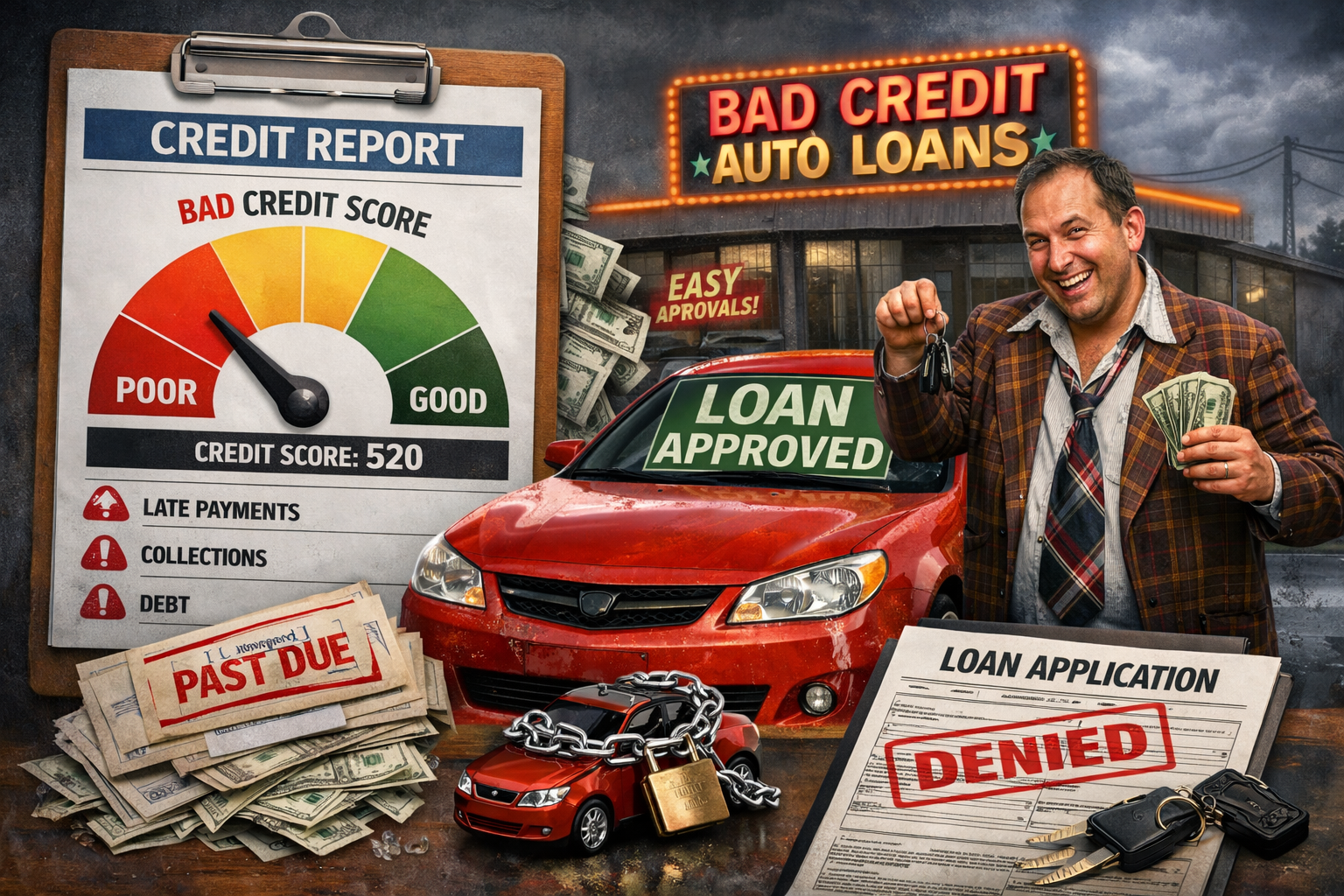
A car loan with bad credit is an auto financing option designed for borrowers with low credit scores, typically below 580. Approval depends on income, debt-to-income ratio, and down payment size. While interest rates are higher than prime loans, structured repayment can help rebuild credit over time.
What Is a Car Loan With Bad Credit
A car loan with bad credit is a secured auto financing product offered to borrowers who do not meet prime credit standards. Because the vehicle acts as collateral, lenders may approve applicants despite prior late payments, collections, or low credit scores. However, risk-based pricing results in higher annual percentage rates (APR).
Most lenders categorize borrowers using scoring models developed by FICO and maintained by credit bureaus such as Experian, Equifax, and TransUnion.
According to the Consumer Financial Protection Bureau, lenders must evaluate a borrower’s ability to repay before issuing financing. This applies to auto lending as well.
Credit Score Ranges Explained
Credit tiers influence pricing, approval probability, and loan structure.
| Credit Tier | FICO Score Range | Risk Level | Typical APR Range* |
|---|---|---|---|
| Super Prime | 720+ | Very Low Risk | 4%–7% |
| Prime | 660–719 | Low Risk | 6%–10% |
| Nonprime | 620–659 | Moderate Risk | 9%–14% |
| Subprime | 580–619 | High Risk | 13%–20% |
| Deep Subprime | Below 580 | Very High Risk | 18%–29%+ |
*APR ranges vary by market conditions and lender underwriting models (based on automotive finance industry data).
Lower credit tiers increase default probability, which directly increases pricing.
How Lenders Evaluate Risk
Approval for a car loan with bad credit depends on multiple measurable variables beyond credit score.
1. Income Verification
Stable and documented income is critical. Lenders generally require:
- Recent pay stubs
- Bank statements
- Tax returns (self-employed borrowers)
2. Debt-to-Income Ratio (DTI)
DTI equals total monthly debt divided by gross monthly income. Many lenders prefer DTI below 45%.
3. Loan-to-Value Ratio (LTV)
LTV compares the loan amount to the vehicle’s appraised value. Lower LTV reduces lender loss risk.
4. Down Payment
A 10%–20% down payment significantly improves approval chances and may reduce APR.
5. Employment Stability
Continuous employment history demonstrates repayment consistency.
Summary: Key Approval Drivers
- Income stability matters more than minor score differences
- Lower LTV reduces risk pricing
- Down payments improve underwriting outcomes
- Affordable vehicle selection strengthens approval
Can You Get Approved With Poor Credit?
Yes, approval is possible through subprime lenders, dealership financing programs, and some credit unions when applying for a car loan with bad credit. Financing structures for borrowers with poor credit profiles are specifically designed to accommodate elevated default risk by adjusting interest pricing, collateral requirements, and contract verification standards.
A car loan with bad credit is typically categorized as risk-adjusted lending, meaning underwriting teams evaluate repayment probability rather than relying solely on historical credit performance. Subprime lending institutions compensate for uncertainty by applying higher APR ranges, shorter grace periods, or more conservative loan-to-value limits. This structure allows access to vehicle financing even for applicants who do not qualify for prime auto loan programs.
Credit unions may offer comparatively favorable terms because many operate under member-based cooperative models. Organizations such as National Credit Union Administration supervise credit union lending practices to ensure consumer protection and financial stability. Borrowers exploring a car loan with bad credit through credit unions should verify membership eligibility requirements.
Dealership financing departments often maintain relationships with multiple subprime finance companies. This network-based approval approach increases the likelihood of securing vehicle financing for a car loan with bad credit, especially for applicants with limited credit history or previous payment delinquencies.
Although approval probability may increase through subprime channels, borrowers should evaluate total repayment obligations carefully. Higher interest charges can significantly raise long-term ownership cost. Applicants pursuing a car loan with bad credit should request written APR disclosure, amortization schedule details, and fee breakdowns before signing contracts.
In modern automotive finance markets, structured lending allows access to transportation even when credit scores are below prime thresholds. However, responsible borrowing practices remain essential when selecting a car loan with bad credit financing program.
Approval likelihood improves when:
- Income exceeds lender minimums
- Requested vehicle is reasonably priced
- DTI remains within acceptable thresholds
- Applicant provides full documentation
There is no universal minimum credit score, but approval probability declines significantly below 550 unless compensating factors exist.
Where to Apply
Different lending sources vary in flexibility, cost, and risk structure.
| Financing Source | Approval Flexibility | Typical Rates | Primary Benefit | Primary Risk |
|---|---|---|---|---|
| Banks | Moderate | Lower | Structured compliance | Stricter criteria |
| Credit Unions | High (member-based) | Competitive | Member-focused pricing | Membership required |
| Online Subprime Lenders | Very High | Higher | Fast comparison | Rate variability |
| Dealership Financing | High | Higher | Convenience | Potential markup |
| Buy Here Pay Here | Very High | Highest | Minimal credit check | High cost |
Credit unions often provide competitive pricing because they operate as member-owned institutions (based on industry practice).
Interest Rates & Total Loan Cost
Interest rates are the primary cost driver in any car loan with bad credit because they directly determine the total borrowing expense over the financing period. The APR (Annual Percentage Rate) reflects the true cost of credit by incorporating interest charges and certain lender fees into a standardized percentage metric.
When evaluating a car loan with bad credit, borrowers should focus on APR rather than only monthly installment size. A lower monthly payment achieved by extending loan duration may still result in higher total interest cost. Subprime auto lending markets often structure repayment schedules to maintain affordability while managing lender risk exposure.
Because risk-based pricing models are commonly used in auto finance, applicants with lower credit scores typically receive higher APR offers. Institutions such as Federal Reserve monitor consumer credit market conditions, which indirectly influence auto loan interest trends. When benchmark interest rates rise, financing costs for a car loan with bad credit may also increase.
Borrowers seeking a car loan with bad credit should compare multiple APR offers before signing agreements. Prequalification programs help estimate interest ranges without triggering hard credit inquiries. This strategy supports better cost management and reduces long-term financial burden.
APR includes:
- Base interest rate
- Certain lender fees
Because pricing is risk-based, borrowers in subprime categories may pay double or triple the interest of prime borrowers.
APR Impact Example ($20,000 Loan, 60 Months)
| APR | Monthly Payment | Total Paid | Total Interest |
|---|---|---|---|
| 6% | $386 | $23,160 | $3,160 |
| 15% | $476 | $28,560 | $8,560 |
| 25% | $587 | $35,220 | $15,220 |
Observation: At 25% APR, interest cost can approach the original principal amount.
Shorter loan terms reduce total interest but increase monthly payments. Borrowers must balance affordability with long-term cost.
Cost Control Takeaways
- Compare total repayment, not just monthly payment
- Avoid extending terms solely to lower installments
- Larger down payments reduce financed balance
- Prequalification allows cost comparison without commitment
How to Increase Approval Chances
Improving financial positioning before applying for a car loan with bad credit can materially change loan terms, approval probability, and total borrowing cost. Because auto financing is priced using risk-based underwriting models, even moderate improvements in measurable financial factors can reduce APR, shorten loan duration, or increase approval probability when seeking bad credit auto financing solutions.
Borrowers searching for a car loan with bad credit should understand that underwriting systems prioritize quantifiable financial stability signals. These signals include verified income consistency, controlled debt obligations, and manageable credit utilization ratios. Strengthening these factors before submitting a formal application can significantly improve negotiation leverage with lenders offering subprime auto loan approval programs.
Lenders evaluate structured data points rather than general intent. Strengthening those data points before submitting an application increases negotiating leverage and reduces dependency on high-cost subprime auto lenders. This principle is especially important when applying for a car loan with bad credit, where underwriting decisions rely on measurable risk indicators instead of personal explanations.
Auto finance underwriting models analyze quantifiable variables, including:
- Credit score tier
- Payment history consistency
- Debt-to-income ratio (DTI)
- Loan-to-value ratio (LTV)
- Verified gross income
- Employment duration
- Existing installment obligations
These inputs are processed through automated risk-scoring systems commonly used across banks, credit unions, and online lenders when evaluating a car loan with bad credit. Institutions referencing scoring frameworks developed by FICO prioritize statistical repayment probability over subjective factors such as personal explanations or financial hardship narratives.
As a result, improving measurable financial indicators directly influences loan pricing, approval odds, and contract structure in bad credit auto financing markets. Borrowers who optimize credit utilization, payment history, and income verification metrics often qualify for more competitive lending offers compared to applicants relying on emergency financing channels.
Modern automotive underwriting relies heavily on algorithmic decision models rather than manual judgment. These automated evaluation systems analyze structured financial data to estimate default probability. For example, consistent installment payment records and stable employment documentation can improve approval probability for a subprime auto loan approval application.
also read: https://fundbulletins.com/bank-statement-loan/
Key performance signals that strengthen loan outcomes include:
- Higher verified monthly income for low credit car financing applications
- Lower revolving credit utilization ratio
- Reduced outstanding debt obligations
- Longer employment stability history
Financial institutions may adjust interest pricing based on aggregated risk signals. When borrowers present stronger data profiles before submitting a car loan with bad credit application, they move closer to prime-tier or near-prime underwriting zones, even if their historical credit score remains suboptimal.
In practice, improving structured financial metrics helps borrowers transition away from high-cost subprime auto loan online offers. Instead, applicants may receive prequalified financing proposals with better repayment structures, lower APR exposure, and more predictable amortization schedules..
For example, increasing a down payment lowers LTV, which reduces projected lender loss exposure in repossession scenarios. Similarly, reducing revolving credit balances improves DTI and may shift an applicant from deep subprime to subprime tier pricing. Even a 20–40 point credit score improvement can meaningfully impact APR ranges in bad credit auto financing structures.
When borrowers strengthen these structured metrics before applying for a car loan with bad credit, they gain measurable advantages:
- Lower APR eligibility
- Access to broader lender networks
- Reduced need for Buy Here Pay Here financing
- Improved contract terms
- Lower total repayment obligation
By contrast, submitting applications without financial preparation often results in reliance on higher-cost subprime auto loan approval channels that compensate for risk through elevated interest rates and stricter contract provisions. Borrowers applying for a car loan with bad credit without optimizing financial positioning may face limited lender choices, higher APR, longer repayment terms, or additional collateral requirements.
From a negotiation perspective, documented improvements—such as higher verified income or lower debt ratios—provide objective leverage when applying for a car loan with bad credit. Dealers and lenders base approval decisions on data thresholds rather than subjective explanations. Meeting stronger underwriting thresholds expands financing options beyond emergency-style or high-risk subprime auto loan programs.
In structured lending environments, numbers drive decisions. Borrowers who optimize quantifiable risk factors before seeking a car loan with bad credit reduce exposure to unfavorable pricing and improve long-term affordability outcomes.
Below are the most impactful financial positioning strategies.
1. Increase Down Payment
A larger down payment directly lowers the loan-to-value (LTV) ratio when applying for a car loan with bad credit. The LTV ratio compares the financed loan amount to the vehicle’s market value at the time of purchase. A lower LTV ratio reduces lender exposure in case of borrower default, vehicle depreciation, or repossession events.
For example:
- 5% down payment → Higher LTV → Higher perceived risk
- 20% down payment → Lower LTV → Reduced risk pricing
Borrowers seeking bad credit auto financing often see measurable APR reductions when increasing their upfront contribution. In addition, a larger down payment lowers monthly installments and reduces the risk of negative equity.
2. Reduce Debt-to-Income Ratio (DTI)
Debt-to-income ratio measures total monthly debt obligations divided by gross monthly income. Many lenders prefer DTI below 40%–45%.
To improve DTI before applying for subprime auto loan approval:
- Pay down revolving credit balances
- Avoid opening new credit accounts
- Increase documented income (if possible)
- Delay large purchases
Even small DTI reductions can influence underwriting decisions when applying for a car loan with bad credit, especially if the credit score is near tier thresholds.
3. Stabilize Employment History
Employment consistency demonstrates predictable income flow. Lenders often prefer at least 6–12 months with the same employer. Borrowers with stable job history are viewed as lower default risk in low credit car financing evaluations.
If possible, avoid changing jobs immediately before submitting a formal application.
4. Correct Credit Report Errors
Before applying for an auto loan with poor credit, review credit reports for inaccuracies. Errors such as outdated collections, duplicate accounts, or incorrect late payments can depress scores unnecessarily.
According to reporting practices from major credit bureaus such as Experian and Equifax, consumers have the right to dispute inaccurate information. Score corrections can improve loan tier placement.
5. Limit Hard Credit Inquiries
Multiple hard inquiries within a short period can temporarily reduce scores. Begin with prequalification offers that use soft inquiries. This protects the score while comparing instant approval car loan online options.
Rate shopping within a limited time frame is generally treated as a single inquiry event under many scoring models developed by FICO, but minimizing unnecessary applications still strengthens financial positioning.
6. Choose a Realistic Vehicle Budget
Selecting a vehicle within a conservative price range improves approval probability. Lenders prefer:
- Reliable resale value
- Moderate mileage
- Vehicle age under 10 years
Requesting financing significantly above income capacity increases rejection risk, especially when applying for a car loan with bad credit through dealership programs.
Financial Positioning Summary
Improving measurable factors before applying can:
- Reduce APR exposure
- Increase approval probability
- Lower total repayment amount
- Improve negotiation power
- Expand lender options beyond high-risk dealers
A strategic approach to financial preparation transforms the outcome of a car loan with bad credit application. Rather than accepting the first available offer, borrowers who optimize DTI, LTV, income documentation, and credit accuracy can materially improve loan structure and long-term affordability.
Increase Down Payment
A higher upfront payment:
- Lowers LTV
- Reduces lender exposure
- May decrease APR
Even a modest additional contribution can improve underwriting results.
Add a Co-Signer
A co-signer with stronger credit may:
- Reduce interest rate
- Increase approval odds
- Improve loan structure
However, co-signers assume full legal repayment responsibility.
Choose an Affordable Vehicle
Lenders prefer:
- Vehicles under 10 years old
- Moderate mileage
- Strong resale value
Higher-priced vehicles increase risk exposure and may lead to rejection.
Improve Debt-to-Income Ratio
DTI can be improved by:
- Paying down revolving balances
- Avoiding new credit applications
- Increasing documented income
Lower DTI signals stronger repayment capacity.
Get Prequalified First
Prequalification often uses a soft credit inquiry, which does not impact credit scores according to reporting practices followed by major credit bureaus. This process allows borrowers to compare multiple loan offers before submitting a formal application. For consumers exploring a car loan with bad credit, prequalification provides transparency into estimated APR ranges, loan terms, and approval likelihood without triggering a hard inquiry.
A soft inquiry—sometimes called a soft pull—reviews limited credit file information for screening purposes. It does not signal active borrowing behavior to scoring models developed by FICO or reported by bureaus such as Experian and TransUnion. Because scoring models typically respond to hard inquiries associated with finalized applications, soft inquiries are excluded from score calculations.
This distinction is particularly important for borrowers seeking:
- Preapproved auto loans for bad credit
- Instant auto loan prequalification
- Online car financing with soft pull
- Subprime auto loan comparison offers
- No impact credit check car loans
When shopping for a car loan with bad credit, submitting multiple hard inquiries across different lenders can temporarily reduce a credit score by a few points. However, most modern scoring models group similar auto loan inquiries within a short window (often 14–45 days) as a single rate-shopping event. Even so, prequalification remains the safest first step.
Benefits of Prequalification
- View estimated APR before committing
- Compare lenders side-by-side
- Identify realistic approval terms
- Avoid unnecessary credit score reductions
- Strengthen negotiation position at dealerships
After reviewing prequalified offers, borrowers may proceed with a formal application that involves a hard inquiry. At that stage, full documentation—income verification, residency confirmation, and debt disclosure—will be required before final approval.
For individuals considering a car loan with bad credit, prequalification acts as a risk-management tool. It supports informed decision-making, encourages competitive rate comparison, and reduces exposure to aggressive dealer financing tactics. Borrowers should still review the final Truth in Lending disclosure carefully, as prequalified terms are estimates and subject to change upon full underwriting review.
Pros & Cons Overview
Advantages
- Access to transportation despite prior credit issues
- Opportunity to rebuild payment history
- Structured installment repayment
Disadvantages
- Higher total borrowing cost
- Risk of repossession if payments lapse
- Potential negative equity in early years
Key Insights
- Approval is possible even with subprime credit profiles.
- Income, DTI, and down payment strongly influence outcomes.
- APR is the primary determinant of total cost.
- Comparing lenders reduces overpayment risk.
- Structured repayment can gradually improve credit standing.
Risks of “Guaranteed Approval” Offers
Advertisements promising instant or guaranteed approval frequently target financially vulnerable borrowers who are actively searching for a car loan with bad credit. These promotions often use persuasive phrases such as guaranteed approval auto loan, no credit check car financing, instant approval car loan online, bad credit auto financing guaranteed, and same-day car loan approval to create urgency and reduce comparison shopping behavior. While some subprime lenders are willing to consider applicants with very low credit scores, no legitimate financial institution can finalize financing without verifying income stability, identity documentation, residency, and repayment capacity.
Auto lenders operate under risk-based underwriting standards that require documented proof of income, employment history, and debt obligations. Federal consumer protection rules require lenders to assess a borrower’s ability to repay before extending credit. Any advertisement implying that income verification or affordability checks are unnecessary should be evaluated carefully. Even lenders specializing in a car loan with bad credit must review at least basic underwriting factors such as debt-to-income ratio (DTI), loan-to-value ratio (LTV), and vehicle valuation data.
In many cases, so-called “guaranteed” offers simply mean the dealership intends to submit applications to multiple subprime finance companies. Approval is never automatic. Terms may also include significantly higher APR, mandatory add-ons, extended loan durations, or strict repossession clauses. Borrowers should request a full written disclosure of:
- Annual Percentage Rate (APR)
- Total repayment amount
- Loan term length
- All dealer add-on products
- Prepayment penalties (if any)
A legitimate lender offering a car loan with bad credit will provide transparent cost breakdowns and allow time for review before signing. Consumers should avoid contracts presented with pressure tactics such as “today-only approval” or incomplete documentation.
From a financial risk perspective, instant-approval marketing is often designed to shift focus from total borrowing cost to quick vehicle access. However, total repayment and long-term affordability remain the most important decision factors. Comparing multiple lenders, reviewing amortization schedules, and confirming licensing status can significantly reduce overpayment risk.
In summary, while access to financing is possible for subprime borrowers, claims of automatic or unconditional approval should be treated cautiously. Responsible lending practices always include verification, documented underwriting, and transparent disclosures.
According to the Federal Trade Commission, misleading financing claims are considered deceptive marketing practices under federal consumer protection law. Advertisements that promote phrases such as guaranteed car loan approval, no credit check auto financing, instant car loan with bad credit, bad credit car dealerships guaranteed approval, or same-day auto loan approval without income verification may violate disclosure standards if material terms are omitted or misrepresented.
The FTC enforces rules that prohibit unfair or deceptive acts in commerce, including misleading representations about loan eligibility, interest rates, or approval certainty. In the auto finance market, dealers and lenders must avoid exaggerating approval likelihood or hiding critical cost information. Marketing language cannot imply that credit history, employment verification, or affordability assessments are irrelevant when those factors are required for underwriting.
Under the federal Truth in Lending Act (TILA), implemented by Regulation Z, lenders must clearly disclose:
- Annual Percentage Rate (APR)
- Total finance charge
- Amount financed
- Total of payments
- Payment schedule
- Loan term length
These disclosures must be provided in a standardized format before the borrower becomes legally obligated. When advertising a car loan with bad credit, lenders must present APR clearly if any interest rate is mentioned. For example, if an advertisement promotes “low monthly payments” or “$0 down auto financing,” it must also disclose qualifying terms and the actual APR if required by regulation.
Misleading advertising commonly occurs when promotions emphasize affordability without showing the full amortization impact. A dealership might highlight a low monthly installment while extending the term to 72 or 84 months at a high interest rate. Although technically approved, the borrower may pay significantly more in total interest. For consumers seeking a car loan with bad credit, this distinction is critical because risk-based pricing often results in higher APR.
The FTC also monitors deceptive add-on practices. Some lenders bundle extended warranties, GAP insurance, service contracts, or credit insurance into financing without clearly explaining cost implications. When these products are rolled into a high-interest loan, total repayment increases substantially. Transparent disclosure is required so borrowers understand whether add-ons are optional or mandatory.
From a compliance perspective, any lender offering a car loan with bad credit must:
- Avoid false claims of guaranteed approval
- Provide clear written disclosures
- Verify borrower identity and income
- Disclose full repayment structure
- Refrain from hidden fees
Consumers should request written documentation before signing and review the Truth in Lending disclosure form carefully. If a lender refuses to provide written terms upfront or discourages comparison shopping, that behavior may indicate elevated risk.
In summary, federal regulations exist to protect borrowers from deceptive auto financing practices. While higher-risk lending is legally permitted, marketing must remain accurate, transparent, and compliant with disclosure requirements. Borrowers considering a car loan with bad credit should prioritize lenders that provide full cost transparency rather than relying on promotional language alone.
Common Red Flags
- No income verification required
- Extremely high APR without disclosure clarity
- Pressure to sign same-day contracts
- Large mandatory add-on fees
- No written amortization schedule
Consumer Protection Box
- Review full APR disclosure before signing
- Confirm total repayment amount
- Verify lender licensing status
- Avoid signing incomplete contracts
Borrowers seeking a car loan with bad credit should compare at least three written offers before committing.
Buy Here Pay Here (BHPH) vs Traditional Financing
Buy Here Pay Here dealerships provide in-house financing for high-risk borrowers. Unlike banks or credit unions, BHPH dealers both sell and finance the vehicle.
How BHPH Financing Works
- Minimal credit screening
- Weekly or biweekly payment schedules
- Higher interest rates
- Limited vehicle selection
While BHPH programs may approve a car loan with bad credit quickly, total borrowing costs are often significantly higher than external financing sources.
Comparison Table
| Feature | Traditional Lender | Buy Here Pay Here |
|---|---|---|
| Credit Check | Yes | Often limited |
| APR Range | Moderate to high | Typically highest |
| Vehicle Selection | Wide market | Dealer inventory only |
| Payment Frequency | Monthly | Weekly/Biweekly |
| Regulatory Oversight | Strong | Varies by state |
According to the Consumer Financial Protection Bureau, borrowers should carefully review contract terms and repossession clauses before agreeing to dealer-based financing.
How to Refinance After Improving Credit
Refinancing allows borrowers to replace an existing auto loan with a new loan at a lower APR once credit improves.
A car loan with bad credit may initially carry high interest. However, after 12–18 months of consistent payments, refinancing can reduce total cost.
When Refinancing Makes Sense
- Credit score increases by 50–100+ points
- Income stabilizes
- DTI improves
- Vehicle retains positive equity
Cost Reduction Example
If a borrower refinances a $15,000 balance from 22% APR to 11% APR with the same remaining term, total interest savings may reach several thousand dollars depending on amortization schedule.
Credit scoring updates are reported by bureaus such as Experian and TransUnion after consistent on-time payments.
Impact on Credit Score
A properly managed car loan with bad credit can support long-term credit rebuilding.
Positive Effects
- On-time payments build payment history (largest FICO factor)
- Credit mix diversification
- Installment balance reduction over time
Negative Effects
- Late payments remain on report up to seven years
- Repossession significantly damages credit profile
- High utilization may increase DTI stress
According to consumer credit reporting standards, payment history represents approximately 35% of many scoring models.
Step-by-Step Application Process
Applying strategically reduces denial risk and unnecessary hard inquiries.
Step 1: Check Credit Reports
Obtain free reports annually to verify accuracy.
Step 2: Calculate Budget
Ensure total transportation costs remain sustainable.
Step 3: Compare Multiple Lenders
Request written APR, term, and total repayment estimates.
Step 4: Get Prequalified
Soft inquiries allow offer comparison.
Step 5: Review Loan Agreement Carefully
Confirm:
- APR
- Total repayment
- Fees
- Prepayment penalties
Step 6: Finalize Purchase
Sign only after understanding full amortization schedule.
A structured approach improves outcomes when applying for a car loan with bad credit.
Key Points
- Approval is possible with stable income and manageable DTI.
- APR determines total repayment more than monthly installment.
- Down payments reduce risk pricing.
- Avoid “guaranteed approval” without full disclosure.
- Refinancing after credit improvement lowers long-term cost.
Conclusion
A car loan with bad credit remains accessible through structured underwriting, income verification, and risk-based pricing. Although interest rates are higher for subprime borrowers, strategic planning, lender comparison, and responsible repayment can reduce long-term cost and support credit rebuilding. Total repayment amount should always guide financing decisions.
Frequently Asked Questions (FAQs)
1. What credit score is needed for auto financing?
Many lenders consider scores below 580 subprime. Approval may still occur below that threshold with strong income and down payment.
2. Can I get approved with a 500 credit score?
Approval is possible, but APR typically exceeds 20% depending on risk assessment and lender policy.
3. Does applying hurt my credit?
Prequalification usually involves soft inquiries, while final applications trigger hard inquiries that may slightly reduce scores.
4. Is no money down possible?
Some lenders allow zero down payment, but higher LTV ratios increase rejection risk and APR.
5. How long before refinancing?
Borrowers typically refinance after 12–18 months of consistent payment history.
6. Does a car loan help rebuild credit?
Yes, on-time payments improve payment history, a major scoring factor.
References
- Consumer Financial Protection Bureau – Auto Loans
https://www.consumerfinance.gov/consumer-tools/auto-loans/ - Federal Trade Commission – Auto Financing & Dealer Practices
https://www.ftc.gov/business-guidance/resources/auto-dealer-advertising-practices - Experian – State of the Automotive Finance Market Report
https://www.experian.com/automotive/automotive-intelligence - Federal Reserve – Consumer Credit Data
https://www.federalreserve.gov/releases/g19/ - National Credit Union Administration – Credit Union Lending Data
https://www.ncua.gov
Disclaimer:
The content provided is for informational purposes only and does not constitute financial, investment, legal, or tax advice. While efforts are made to ensure accuracy, no guarantees are given regarding completeness or reliability. Any action you take upon the information is strictly at your own risk. We recommend consulting a licensed financial advisor or professional before making financial decisions