Introduction
Have you ever wondered why street lamps get dimmer over time? The answer is simple: dust. Dirt, grime, and airborne particles settle on lamp covers, blocking light and reducing brightness by up to 80% in severe cases . Traditional street lamps require manual cleaning by maintenance crews—expensive, time-consuming, and often neglected.
But here’s the good news: self-cleaning street lamp research is not science fiction. Real dust resistant lamp projects exist today. Engineers in China, Japan, and South Korea have developed working prototypes and patented technologies that automatically clean street lamps without human intervention.
This guide covers seven real self-cleaning street lamp projects that have been researched, patented, and in some cases, already implemented. You’ll learn how they work, who developed them, and what the future holds for dust-resistant lighting technology.
Fact #1: Mechanical Brush Cleaning System (China Patent CN220321258U)
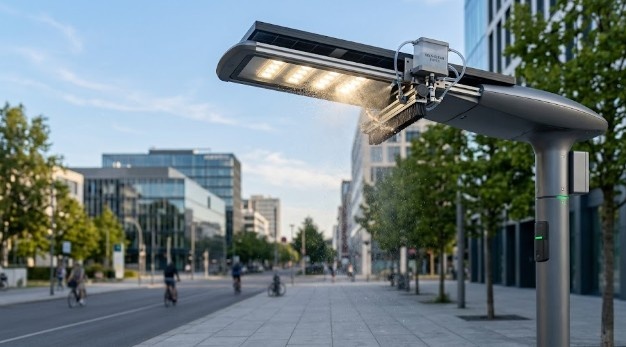
One of the most practical self cleaning street lamp research projects comes from a Chinese patent filed in 2023. The design uses a mechanical brush system that physically sweeps dust off the lamp surface .
How It Works
| Component | Function |
|---|---|
| Drive motor | Powers a reciprocating screw mechanism |
| Reciprocating screw | Moves the cleaning assembly back and forth |
| Cleaning brush | Silicone brush that sweeps dust without scratching |
| Storage net box | Collects dust and holds insect repellent |
| Electric push rod | Lowers the brush when cleaning is needed |
The system uses a reciprocating screw mechanism—a threaded rod with two opposite spiral grooves. When the motor turns the screw, the cleaning assembly moves back and forth along the lamp surface, sweeping dust away .
Additional Features
The patent also includes:
- Insect repellent storage: The cleaning box holds solid insect repellent (chlorfluethrin) that releases scent through a ventilated mesh, keeping bugs away from the light source
- Automatic retraction: When not in use, the cleaning brush retracts into a storage slot, staying out of sight
Summary:
- Mechanical brush system with reciprocating screw drive
- Silicone brush sweeps dust without scratching glass
- Built-in insect repellent storage
- Brush retracts when not in use
Fact #2: Water Spray Cleaning System (China Patent CN216243779U)
Another existing dust resistant lamp project uses water rather than brushes. This design, patented by Yangzhou Yingrui Landscape Lighting in 2022, combines rainwater collection with automated spray cleaning .
How the Water System Works
| Component | Function |
|---|---|
| Water storage tank | Collects rainwater through a funnel opening |
| Filter screen | Removes debris from collected rainwater |
| Submersible pump | Pumps water to the spray nozzles |
| Inward-inclined nozzles | Spray water onto the lamp surface and cleaning brush |
| Reciprocating screw | Moves the cleaning assembly across the lamp face |
Two-Stage Cleaning Process
The system cleans in two ways simultaneously:
- Wet brushing: The nozzles wet the cleaning brush before it sweeps, improving dust removal
- Direct flushing: Nozzles spray water directly onto the lamp surface to wash away stubborn grime
Water Source
The tank collects rainwater through a funnel at the top. A filter screen removes leaves and debris. When natural water is insufficient, the system can also connect to municipal water supply .
Summary:
- Rainwater collection eliminates need for external water
- Dual-action cleaning: wet brushing + direct flushing
- Filter prevents nozzle clogging
- Can switch to municipal water when rainwater is scarce
Fact #3: Dual-Surface Solar Panel Cleaning (China Patent 2025)
The most recent self cleaning street lamp research comes from Shenzhen Chenze Technology, which filed a patent in December 2025 for a solar-powered self-cleaning street lamp .
What Makes It Unique
This design addresses a specific problem: solar panels on street lamps also get dirty. When dust covers a solar panel, power generation drops significantly. This project cleans both the lamp AND the solar panel.
Bidirectional Air Blowing System
| Feature | Description |
|---|---|
| U-shaped moving clamp | Wraps around the solar panel |
| Air guide cylinder | Directs airflow across surfaces |
| Gas nozzles | Blow air onto panel surfaces |
| Heating wire | Warms air to soften stubborn dirt |
| Two-way reciprocating mechanism | Moves cleaning assembly across entire surface |
The system uses air blowing rather than water or brushes. Hot air can soften hardened dirt while blowing particles away . This approach works especially well for solar panels where scratching would reduce efficiency.
Summary:
- Cleans both lamp and solar panel
- Air blowing technology (no water needed)
- Heated air for stubborn grime
- Dual-direction movement for complete coverage
Fact #4: Demisting and Brightness-Based Self-Cleaning (Japan Patent JP6859545)
Japanese researchers have developed a unique approach that triggers cleaning based on light levels. Patent JP6859545, filed in 2020, describes a system that automatically activates cleaning when brightness drops below a threshold .
How It Detects the Need to Clean
The system uses a light sensor mounted on the lamp post. When dust accumulation reduces light output below a preset level, the cleaning mechanism activates automatically .
Moisture Removal Function
A distinctive feature of this Japanese dust resistant lamp project is its ability to remove internal moisture:
| Component | Purpose |
|---|---|
| Moisture absorption box | Collects humidity inside the lamp housing |
| Exhaust fan | Expels moist air to the outside |
| Dehumidification system | Prevents fogging and condensation |
When the lamp detects low brightness, it may be due to external dust OR internal fogging. The system addresses both causes automatically .
Water Collection for Cleaning
The design also includes a water collection tank that gathers rainwater, which is then pumped to spray nozzles for cleaning the lamp surface .
Summary:
- Light sensor triggers cleaning when brightness drops
- Automatic moisture removal prevents internal fogging
- Rainwater collection supports spray cleaning
- Integrated approach to multiple cleaning needs
Fact #5: Airflow-Based Dust Prevention (China Patent CN213577046U)
Sometimes the best way to clean is to prevent dust from settling in the first place. Patent CN213577046U from 2020 describes a low-light lamp that uses strategic airflow to keep dust away .
How Airflow Prevents Dust
The design includes:
| Feature | Function |
|---|---|
| Heat dissipation holes | Allow hot air to exit |
| Inverted bowl dust covers | Prevent dust from entering through vents |
| Strategic airflow path | Directs air movement to reduce dust accumulation |
Why This Matters
In low-light applications (like security cameras or night surveillance), lamps must run continuously for long periods. Standard cooling vents allow dust to enter. This design uses specially shaped dust covers that block particles while allowing heat to escape .
Summary:
- Prevents dust entry rather than cleaning after
- Inverted bowl covers block particles
- Maintains heat dissipation while blocking dust
- Ideal for continuous-operation low-light lamps
Fact #6: UV Coating for Dust Resistance (South Korea Patent KR20090039014A)
South Korean researchers have explored chemical solutions rather than mechanical cleaning. Patent KR20090039014A from 2007 describes a lamp with UV coating that makes surfaces resistant to dust and moisture .
How UV Coating Works
| Coating Type | Function |
|---|---|
| Aluminum vacuum deposition | Creates reflective metallic surface |
| UV curing paint layer | Hard, smooth surface that resists dirt adhesion |
| Self-cleaning properties | Dust slides off more easily |
Additional Features
The Korean design also includes:
- Exhaust valve to maintain vacuum inside the housing
- Improved reflectivity from aluminum coating
- UV protection to prevent cover discoloration
Summary:
- Chemical approach to dust resistance
- UV-cured coating creates slippery surface
- Aluminum layer improves light reflection
- Exhaust valve maintains internal vacuum
Fact #7: Early Pioneer Technology (2004 Chinese Patent)
The history of self cleaning street lamp research goes back further than you might think. A Chinese patent from 2004 (application number 200420038316.1) described a self-cleaning street lamp using fans to blow dust away .
The Original Design
| Component | Function |
|---|---|
| Suction fan | Draws dust away from lamp surface |
| Blower fan | Directs air across the lamp face |
| Time controller | Automates cleaning cycles |
| Dust outlet | Expels collected particles |
The Problem It Solved
According to the patent documentation, up to 50% of street lamps in Chinese cities had reduced brightness due to dust accumulation, with some losing 30-80% of their original light output . This early design aimed to address that problem automatically.
Summary:
- Pioneering 2004 design using fans
- Addressed 50%+ of lamps with dust issues
- Time-controlled automatic operation
- Reduced maintenance costs significantly
Comparison of Self-Cleaning Technologies
| Technology | Cleaning Method | Power Source | Best For | Patent Year |
|---|---|---|---|---|
| Mechanical Brush | Silicone brushes | Electric motor | General street lamps | 2023 |
| Water Spray | Rainwater + pumps | Solar/Electric | Dry dusty areas | 2022 |
| Air Blowing | Compressed air | Solar/Electric | Solar panels | 2025 |
| Demisting System | Spray + moisture removal | Electric | Humid regions | 2020 |
| Airflow Prevention | Strategic vents | Passive | Continuous operation | 2020 |
| UV Coating | Chemical treatment | Passive | Harsh environments | 2007 |
| Fan System | Suction + blowing | Electric | Early adopters | 2004 |
Also Read: Framework Homeownership Making an Offer Answers: Complete Guide
Frequently Asked Questions
1. Do self-cleaning street lamps actually exist?
Yes. Multiple working prototypes and patented technologies have been developed in China, Japan, and South Korea. Some designs use mechanical brushes, others use water sprays or air blowing .
2. How do self-cleaning street lamps work?
Most systems use either mechanical brushes that sweep dust away, water sprays that wash the surface, or airflow systems that blow dust off. Some use chemical coatings that make surfaces resistant to dust adhesion .
3. What is the most recent self-cleaning street lamp research?
The most recent patent is from Shenzhen Chenze Technology (December 2025), which uses bidirectional air blowing to clean both the lamp and solar panels .
4. Do these lamps clean themselves automatically?
Yes. Most designs include automatic triggers—either timers, light sensors that detect brightness drops, or remote control systems .
5. How much maintenance do they save?
According to the 2004 Chinese patent documentation, dust can reduce lamp brightness by 30-80% on traditional lamps. Self-cleaning designs eliminate manual cleaning, saving significant labor costs .
6. Do self-cleaning lamps use electricity to clean?
Some do (mechanical brushes, pumps), while others use passive methods (UV coatings, airflow design). Solar-powered systems can use the energy they generate to run cleaning cycles .
7. Are these lamps available for purchase?
Some commercial versions exist, but most remain patented technologies awaiting licensing or mass production. Contact patent holders for commercialization inquiries.
8. What about insect repellent features?
Some Chinese patents include insect repellent storage (chlorfluethrin solid tablets) that releases scent through the cleaning assembly, keeping bugs away from the light .
Summary: Self-Cleaning Street Lamp Research
Real self cleaning street lamp research has produced multiple working technologies. Dust resistant lamp projects exist across China, Japan, and South Korea, with patents dating back to 2004 and continuing through 2025.
Key Takeaways
- Mechanical brush systems (2023) use silicone brushes and reciprocating screws to sweep dust away
- Water spray systems (2022) collect rainwater and use pumps to flush lamp surfaces clean
- Air blowing systems (2025) use heated air to remove dust from both lamps and solar panels
- Demisting technology (2020) triggers cleaning when brightness drops and removes internal moisture
- Airflow prevention (2020) stops dust from entering lamps through specially shaped vent covers
- UV coating technology (2007) creates slippery surfaces that repel dust and moisture
- Pioneer fan systems (2004) used suction and blowing to remove dust decades ago
The most important takeaway? Self-cleaning street lamps are not future technology—they exist today. From mechanical brushes to rainwater sprays to UV coatings, engineers have developed multiple solutions to the dust problem that has dimmed street lights for generations. The challenge now is bringing these technologies to market at scale.
Conclusion
The next time you walk under a dim street lamp, know that the technology to keep it bright already exists. Self-cleaning street lamp research has produced dozens of working designs. Dust-resistant lamp projects have been patented, prototyped, and in some cases, deployed.
Whether through silicone brushes moving on reciprocating screws, rainwater tanks feeding spray nozzles, or UV coatings that repel dust before it settles, the solutions are ready. The question is not whether we can build self-cleaning lamps, but when cities will invest in them.
For municipalities tired of sending crews to clean lamps manually—or worse, accepting dim lights that waste energy and compromise safety—these technologies offer a clear path forward.
The future of street lighting is not just brighter. It’s cleaner, more efficient, and self-sufficient. And that future is already here.
References
- Patent Guru. “一种具备自清洁功能的高光效路灯” (A High-Efficiency Street Lamp with Self-Cleaning Function). CN220321258U. Filed July 14, 2023.
- Malmö University. “Omkonstruktion av lampa Candy för framtida IP44-klassificering” (Redesign of Lamp Candy for Future IP44 Classification). 2024.
- Google Patents. “Dustproof self-cleaning LED lighting street lamp”. CN216243779U. Filed September 29, 2021.
- Qixin.com. “深圳辰泽科技有限公司专利信息” (Shenzhen Chenze Technology Patent Information). 2025.
- Google Patents. “Lamp device for waterproof and dustproof having a uv-coating layer”. KR20090039014A. Filed October 17, 2007.
- J-GLOBAL. “除曇機能付き且つ明度不足時に自浄可能な街灯” (Street Lamp with Defogging Function and Self-Cleaning When Brightness is Insufficient). JP6859545. Filed June 19, 2020.
- Google Patents. “Low light level lamp of dust-protection type”. CN213577046U. Filed December 3, 2020.
- 1633.com. “一种能自动清洁灯罩的路灯” (A Street Lamp That Can Automatically Clean the Lampshade). 2004.
- izhuanli.com. “一种防尘自洗式LED照明路灯” (A Dust-Proof Self-Cleaning LED Lighting Street Lamp). CN216243779U. Filed September 29, 2021.
Disclaimer:
The content provided is for informational purposes only. While efforts are made to ensure accuracy, no guarantees are given about completeness or reliability. Patent information and technology status may change over time. Any action you take based on this information is at your own risk. Commercial availability of these technologies should be verified with patent holders or manufacturers.